
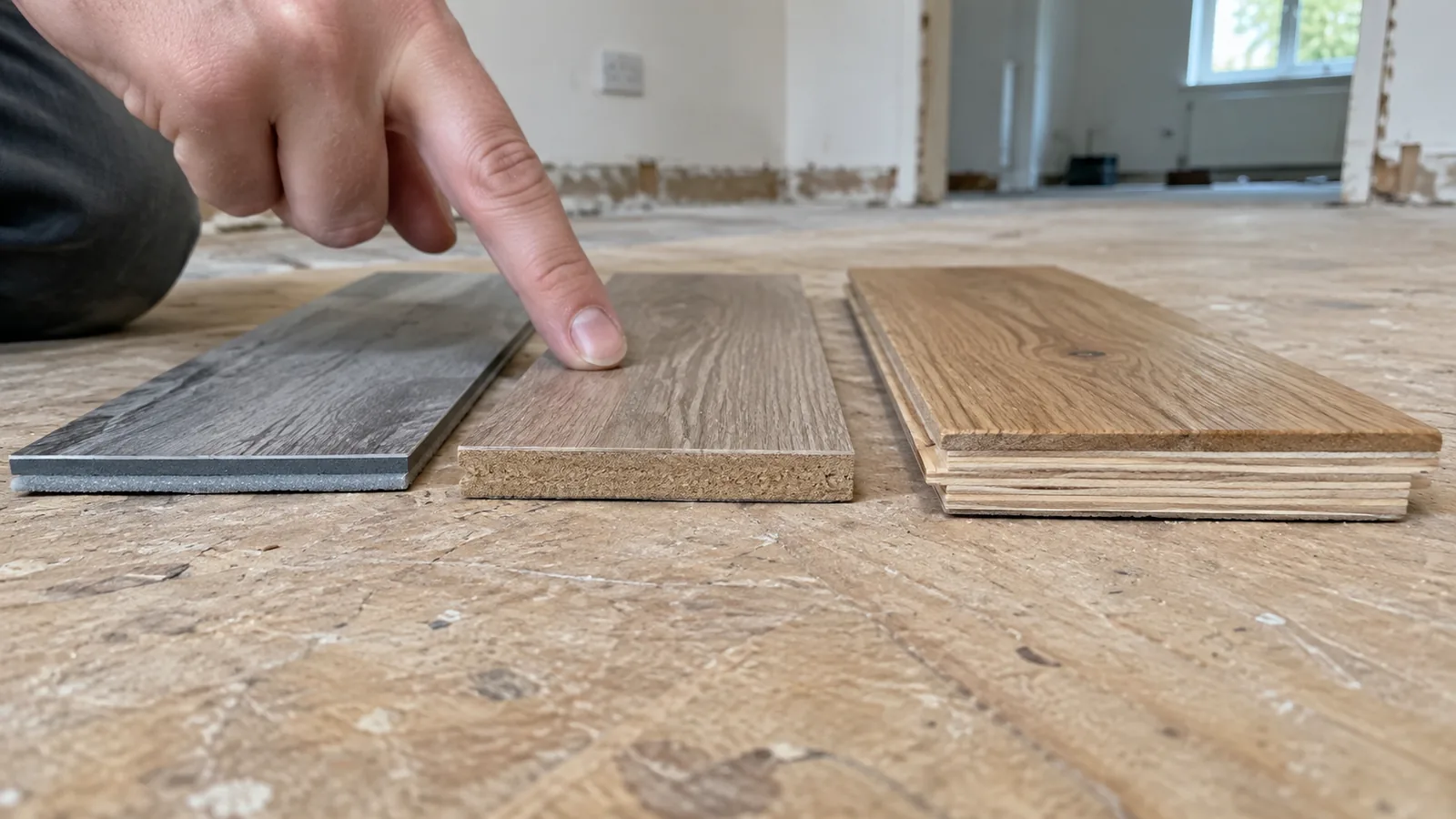
Quick verdict
Choose rigid-core LVP if
- The room has water: kitchen, bathroom, laundry, basement
- You have pets and children and want one floor through the house
- You will install it yourself as a floating click floor
Choose laminate if
- Scratch resistance matters more than water resistance
- The rooms are mostly dry: living room, bedrooms, hallways
- You want a convincing wood look at the lowest price
Choose engineered hardwood if
- You want real wood and accept that it dents and scratches
- The wear layer is thick enough to sand and refinish later
- The rooms stay dry and the humidity stays stable
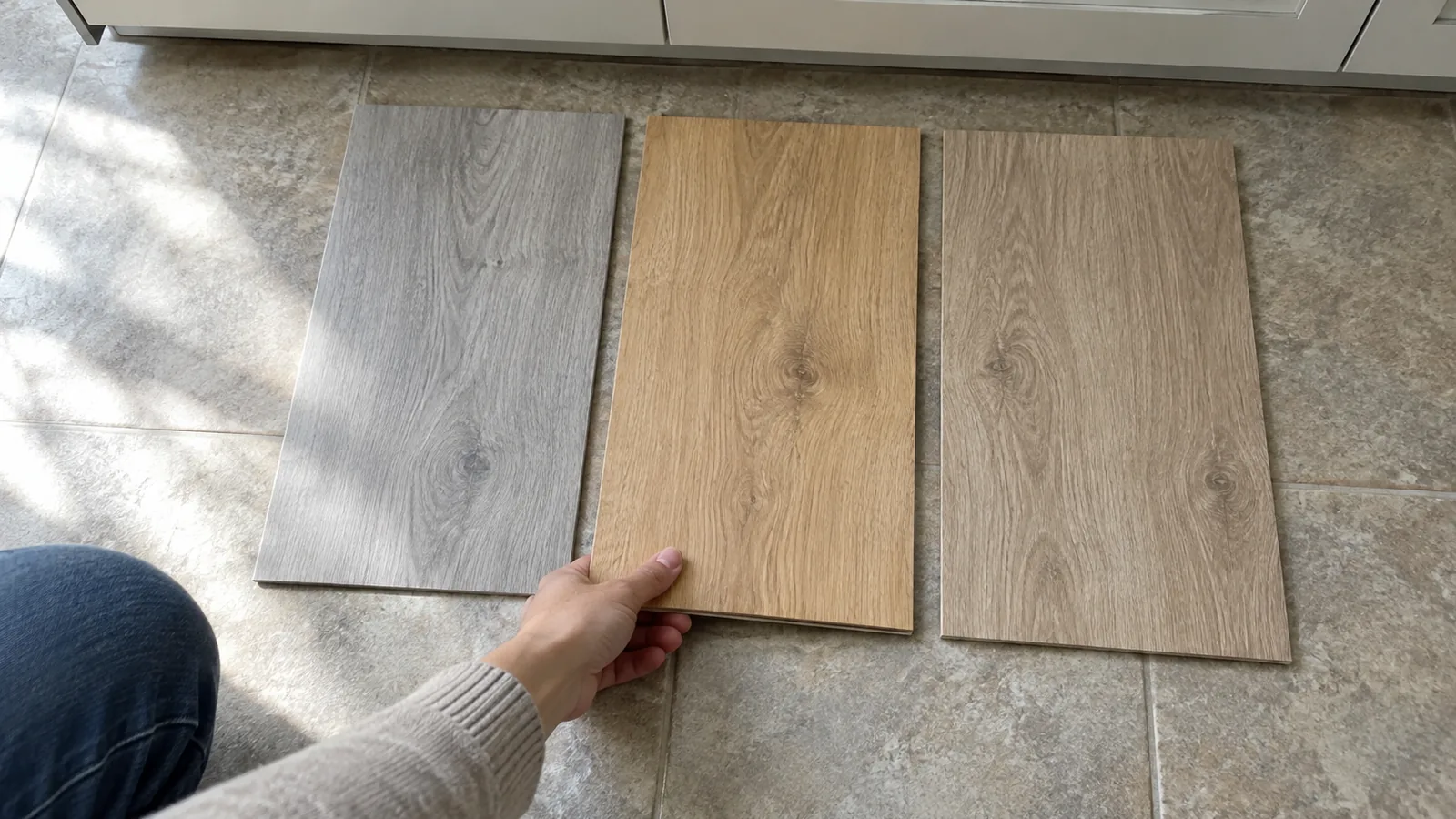
The three floors at a glance
This table is our assessment of typical mid-range products, built from the sources cited further down. A cheap product in any category can lose rows it would normally win, and a premium one can win rows it would normally lose.
| Factor | Rigid-core LVP | Laminate | Engineered hardwood |
|---|---|---|---|
| Top surface | Clear vinyl wear layer over a printed film | Hard resin overlay over a printed decor layer | Real wood with a factory finish |
| Core | Rigid polymer (SPC or WPC) | Compressed wood fibre (HDF) | Plywood, or HDF on composite products |
| Spills and wet mopping | Best | Good on wet-rated lines with a sealed perimeter | Wipe up fast; avoid wet mopping |
| Scratches | Good with a 12 to 20 mil wear layer | Best | Weakest, but repairable |
| Dents | Good; SPC better than WPC | Good | Weakest in soft species |
| Comfort and sound | Good; WPC is softer and quieter | Can sound hollow without a good underlay | Best when glued or nailed down |
| Can be sanded | No | No | Yes, if the wear layer is thick enough |
| Installed cost per sq ft | $4 to $16 | $4 to $14 | $7 to $20 |
Cost ranges are from HomeGuide's flooring installation cost guide (published February 2026, checked October 2026). The cost section breaks them down.
What each floor is made of
The names hide the most important fact: which layer you are walking on, and what sits under it. Read the diagram top to bottom, then the key.
- ALVP wear layer: clear vinyl, often with a urethane top coat. Its thickness, quoted in mil, is the main durability number.
- BPrint film: the wood image. Once the wear layer wears through, the pattern goes with it.
- CRigid core: SPC (solid polymer core) is denser and resists dents; WPC (sold as wood plastic composite or expanded polymer core) is lighter, softer and quieter.
- DAttached pad: optional. Adds comfort and sound control.
- ELaminate wear layer: a clear, hard resin overlay. Its abrasion resistance is quoted as an AC class, not a thickness.
- FDecor layer: a high-resolution photograph of wood or stone.
- GHDF core: wood fibres compressed under heat and pressure. Stiff and stable, but it swells if water reaches it.
- HBacking: a balancing layer, typically melamine, that resists moisture from below.
- IReal wood wear layer: the only layer in this diagram that can be sanded back to fresh material.
- JCore: cross-laminated plywood, or HDF and other composites on "composite engineered" products.
- KBacker: a balancing veneer or layer that keeps the plank flat.
Sources for each column: the Resilient Floor Covering Institute's rigid core overview (SPC denser and more dent-resistant, WPC lighter, more comfortable and better acoustically), MSI's guide to LVP layers, the North American Laminate Flooring Association's laminate construction page, and the NWFA Refinishable Program, which separates engineered wood (real wood throughout) from composite engineered wood (real wood on the wearing surface only, over HDF or another composite).
The idea of a real-wood face over a cheaper, stabler core is the same one used in furniture; our solid wood vs veneer guide explains why the core matters as much as the face.
Water: what "waterproof" covers
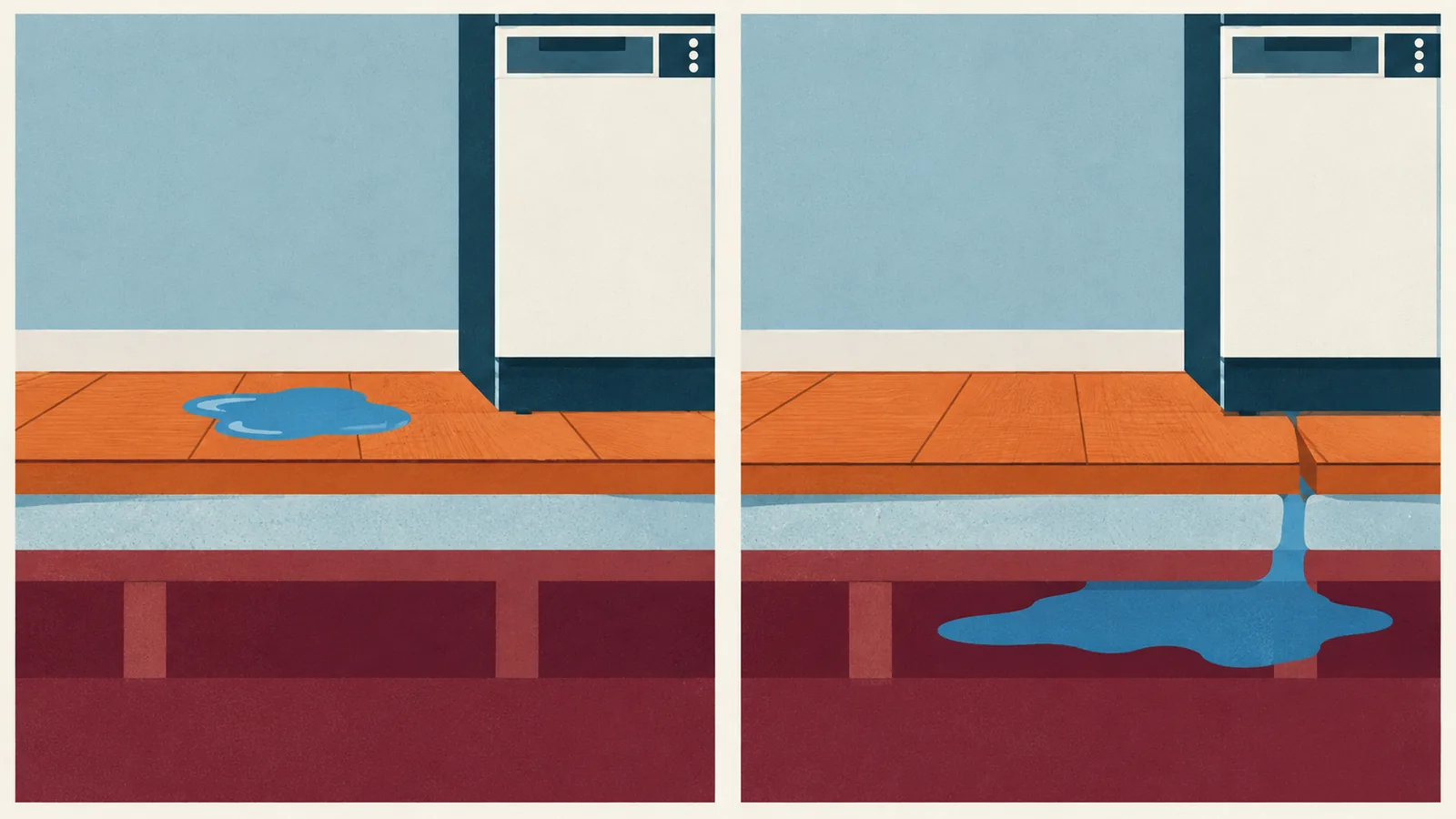
The word on the box is about the plank, not the floor. A rigid vinyl core does not swell, and a wet-rated laminate resists spills that sit on top. But water does not stay on top. It finds the seams, runs to the walls, and soaks the subfloor from leaks you cannot see. The fine print of each product says exactly where its promise stops.
| What the document says | Rigid-core LVP (LifeProof) | Laminate (Pergo WetProtect) | Engineered (Kentwood) |
|---|---|---|---|
| Spills and mopping | Waterproof plank; remove standing water, urine and other liquids promptly | Covers household spills, pet accidents and steam, wet or damp mopping | Not described as water-resistant |
| Seams and edges | Seal expansion gaps around wet areas with 100% silicone | Full cover only if the perimeter is sealed as the instructions say | Not for full bathrooms or laundry rooms |
| Flooding and leaks | Not for rooms prone to flooding; cannot prevent mould or damage from flooding | Not designed for flooding, plumbing accidents or leaking appliances | Exposure to elevated humidity may void the warranty |
| Water from below | Cannot seal an existing floor from moisture or hydrostatic pressure | Not designed for moisture in or under the subfloor | Subfloor moisture must be tested before installation |
Sources: the LifeProof Vinyl Plank installation instructions, the Pergo laminate limited warranty (effective March 2026) and the Kentwood engineered installation guide (December 2025). Pergo's own installation instructions for its wet-rated laminate also say it should not go over a floor with a sump pump or in a room with a floor drain. Other brands word things differently, so read the warranty for the exact product before you buy.
The practical rule: none of these floors replaces fixing a leak. A slow drip under a dishwasher can rot a subfloor under any of them while the planks on top look fine.
Scratches, dents, and pets
Scratches depend on the top layer; dents depend on the core. Laminate's resin overlay is the hardest of the three surfaces, which is why it holds up to claws, grit and chair legs. LVP depends almost entirely on its wear layer: MSI quotes wear layers from 4 to 40 mil and suggests 12 to 20 mil for households with pets or busy entries. Engineered wood scratches and dents like any wood floor of the same species, but those marks can be sanded out if the wear layer allows.
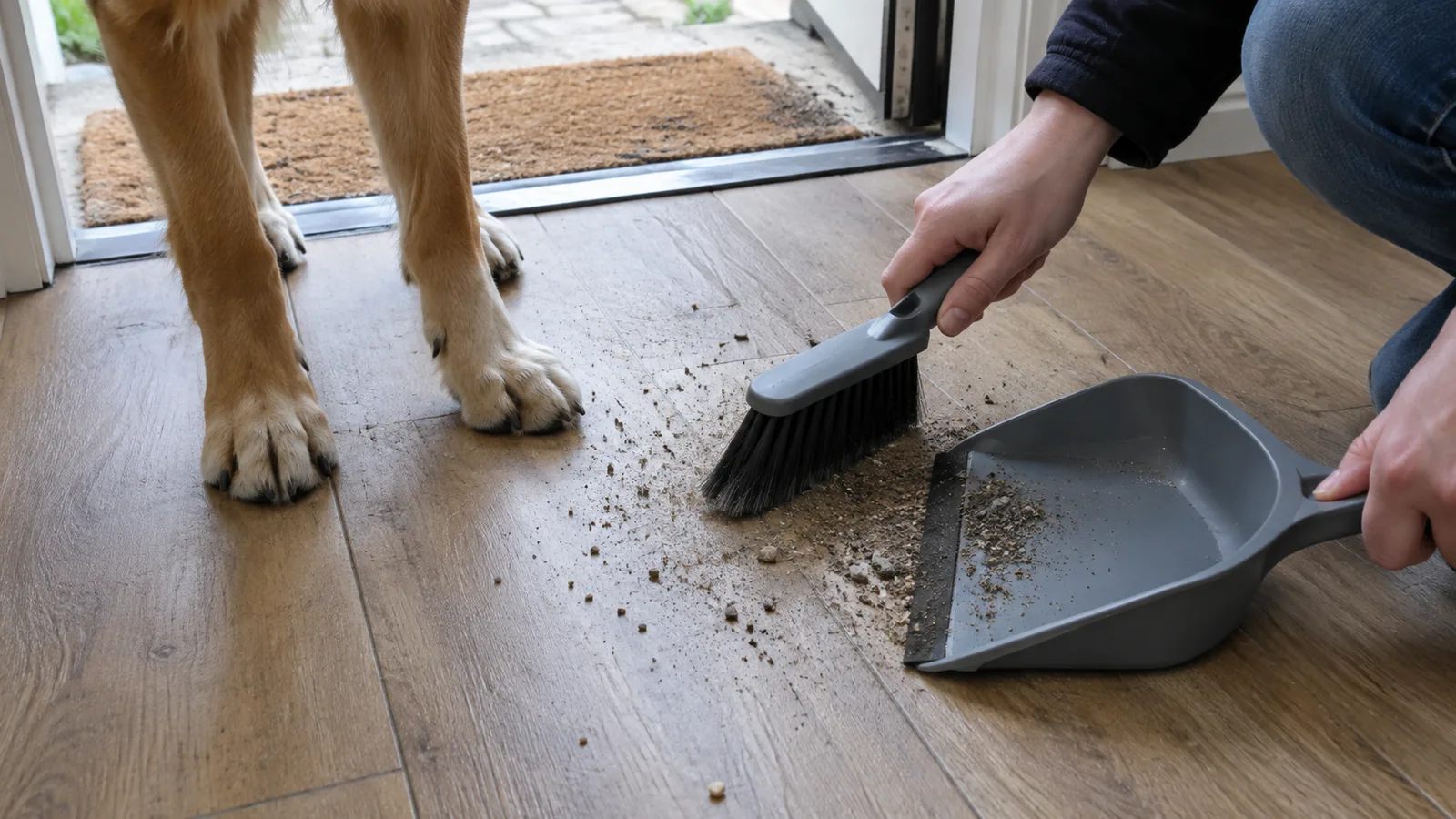
- Dogs: laminate or a 20 mil LVP. Pergo's laminate warranty includes pet scratch and pet stain cover; LifeProof's care section simply says to keep pets' nails trimmed.
- Heavy furniture: LifeProof asks for floor protectors at least 1 in (25 mm) across under heavy furniture and rubber, not plastic or metal, chair casters. SPC resists dents better than the softer WPC.
- Accidents and bowls: LVP and wet-rated laminate cope; on engineered wood, put a mat under the water bowl and wipe accidents up quickly.
Comfort, sound, and sunlight
A floating floor sits on an underlay rather than being fixed down, and a thin, stiff floor over a hard subfloor can sound hollow and clicky underfoot. A better underlay, a softer WPC core, or a glued or nailed engineered floor all reduce that. The RFCI notes that cork or another acoustic underlayment adds warmth and sound absorption to rigid core floors. HomeGuide prices underlayment at $0.50 to $3.50 per sq ft installed.
Sun changes all three. LifeProof warns that long-term direct sunlight can make its vinyl discolour, fade or buckle, and recommends window treatments or UV-tinted glass. Pergo's laminate warranty includes fade resistance. Real wood changes colour with light by nature: Kentwood tells installers to cover the whole floor if they protect it at all, so a partly covered area does not change colour unevenly. Move rugs now and then on a sunny engineered floor; our rug size guide covers runners for kitchens and halls.
Installation, subfloors, and radiant heat
| Requirement | Rigid-core LVP (LifeProof) | Laminate (Pergo, Shaw) | Engineered (Kentwood) |
|---|---|---|---|
| Methods | Floating click only; must not be glued, nailed or fastened down | Floating; movement must not be restrained by glue, nails or fixed objects | Nail-down, full-spread glue or floating, depending on the collection |
| Subfloor flatness | Within 1/4 in in a 10 ft radius (6 mm in 3 m), and 1/16 in under a 3 ft straightedge | No more than 3/16 in unevenness per 10 ft span (5 mm in 3 m) | Within 3/16 in over 10 ft, or 1/8 in in a 6 ft radius |
| Expansion gap | 1/4 in (6 mm) at walls and fixed objects | 3/8 in (10 mm) minimum under door frames and wall base (Pergo) | As set for each method |
| Radiant heat | Subfloor no warmer than 85°F (29°C) | Surface never set above 85°F (29°C) (Shaw) | Surface never above 80°F (26°C); not for acacia or hickory |
Sources: LifeProof instructions, Pergo Pro + WetProtect installation instructions (January 2026), Shaw's laminate over radiant heat guidance (which also says to change the setting by only 4 to 5 degrees a day) and the Kentwood guide. These are single brands: use them to know what to ask, not as the rule for your product.
Two consequences people miss. First, a floating floor goes in after cabinets and islands, never under them, because pinning it down stops it moving. Second, stairs are never floated: a Beaulieu stair nose installation guide says that on stairs the floor is glued down, as building code requires, so check that a matching stair nose exists before you commit to a plank for a whole floor that includes a staircase.
Refinishing, lifespan, and resale
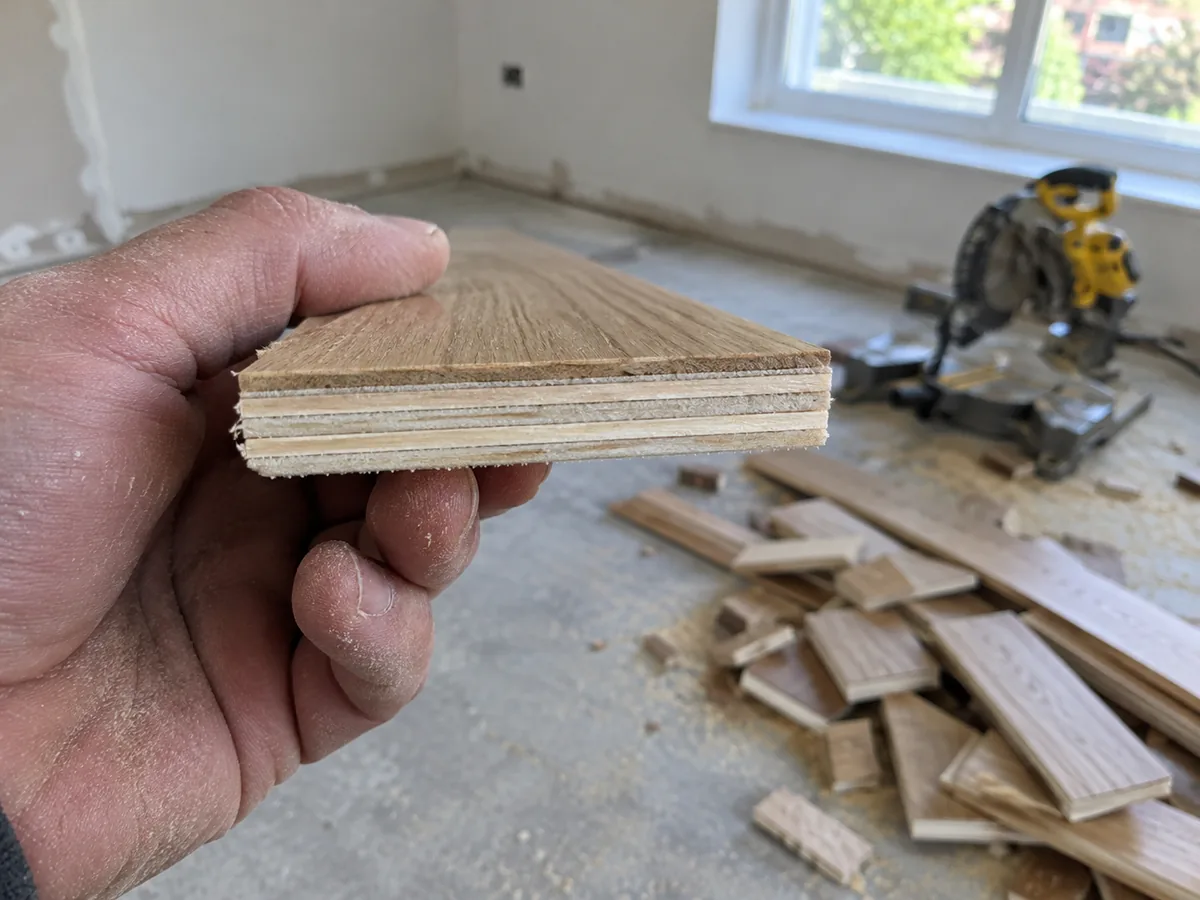
This is the one real advantage engineered wood has over the other two. When LVP or laminate wears through to the print, the plank is finished and has to be replaced. Engineered wood can be sanded back to fresh wood and refinished, provided enough wood is left on top. The chart puts the numbers on one scale.
The numbers: MSI quotes LVP wear layers of 4 to 40 mil (1 mil is a thousandth of an inch, so 12 mil is about 0.3 mm and 20 mil about 0.5 mm). The NWFA Refinishable Program requires at least 2.5 mm of wear layer on factory-finished products and 3.2 mm on unfinished ones before it certifies an engineered floor as refinishable. Hardwood Floors magazine notes that engineered wear layers range from paper-thin up to 1/4 in (6.35 mm), and that a normal sanding often removes less than 1/32 in (about 0.8 mm).
So how many refinishes? Nobody can promise a number: the magazine says it depends on the sander's skill, the equipment, the remaining wear layer and how flat the floor is. A wear layer below the NWFA's 2.5 mm minimum would not be certified as refinishable, so ask the maker whether it approves a light screen and fresh finish coat instead of a full sanding.
Lifespan follows from that: LVP and laminate last until the wear layer wears through or the planks are damaged, while a thick-wear-layer engineered floor can be renewed. On resale, we found no current, neutral study that prices one of these floors against another, so treat claims that one adds value as opinion. Real wood is the floor that listings name; whether buyers pay for it depends on the market and the condition of the floor.
Installed cost
| Floor | Material per sq ft | Installed per sq ft | Example: 200 sq ft room, installed |
|---|---|---|---|
| Luxury vinyl plank | $2 to $10 | $4 to $16 | $800 to $3,200 |
| Laminate | $1 to $6 | $4 to $14 | $800 to $2,800 |
| Engineered wood | $2 to $9 | $7 to $20 | $1,400 to $4,000 |
Per square foot figures are from HomeGuide (February 2026); the 200 sq ft column is our multiplication. Fixr's hardwood installation guide (updated January 2025) gives a similar $8 to $14 per sq ft for installed engineered wood. Both were checked in October 2026; get local quotes, because prices vary by region.
The extras often decide the real gap: HomeGuide lists underlayment at $0.50 to $3.50 per sq ft, subfloor replacement at $2.20 to $4.75 per sq ft, and old floor removal on top. A floor that needs a self-levelling compound to meet a 3/16 in in 10 ft tolerance costs more whatever you lay on it.
Which floor for which room
| Room | Best fit | Workable | Avoid or check first |
|---|---|---|---|
| Kitchen | Rigid-core LVP | Wet-rated laminate with a sealed perimeter | Engineered wood near the sink and dishwasher unless you wipe up fast |
| Full bathroom | Rigid-core LVP, caulked at the tub and toilet | Wet-rated laminate, if the maker allows bathrooms | Engineered wood (Kentwood rules out full bathrooms); laminate where there is a floor drain |
| Basement | Rigid-core LVP after a moisture test | Laminate within the maker's slab moisture limits | Any floor over a slab that fails its moisture test; laminate over a sump pump |
| Living room | Any; engineered for real wood | Laminate for scratch resistance on a budget | Thin-wear-layer LVP in a sunny room without blinds |
| Bedroom | Engineered wood or laminate with a good underlay | WPC LVP for a softer, quieter feel | Hollow-sounding floating floors over a bedroom below, without acoustic underlay |
| Stairs | Engineered wood, glued or nailed | LVP or laminate with a matching stair nose, glued down | Any floating installation; a plank with no matching nose |
Our assessment, based on the installation guides cited above. A laundry room follows the bathroom row; our laundry room layout guide covers the rest of that room's finishes.
How each floor fails
| Floor | Typical failure | Usual cause | What it takes to fix |
|---|---|---|---|
| Rigid-core LVP | Gaps, peaked joints or buckling | Strong sun or heat, a floor pinned under cabinets, no expansion gap | Lift and relay the area; replace damaged planks |
| Rigid-core LVP | Dull, scuffed traffic lanes | Thin wear layer, grit, rubber-backed mats | Replace the planks; it cannot be refinished |
| Laminate | Swollen, raised plank edges | Water through the joints or an unsealed perimeter | Replace the planks; swollen HDF does not go back |
| Laminate | Bounce, clicking, hollow sound | Uneven subfloor, wrong or doubled underlay | Level the subfloor and relay |
| Engineered wood | Cupping or seasonal gaps | Humidity outside the maker's range (30 to 50% RH for Kentwood), moisture from below | Fix the humidity first; refinish once it settles |
| Engineered wood | Sanded through to the core | Too thin a wear layer, or an aggressive sanding | Replace the boards |
Most of these failures are installation and environment, not product. Keep the receipt, the warranty and a spare box of planks, because a replacement plank from a later batch may not match.
How to read the spec sheet
| Spec | What it tells you | What to look for |
|---|---|---|
| Wear layer, in mil or mm (LVP) | How much clear vinyl protects the print | 12 to 20 mil for most homes; 20 mil or more for pets and entries |
| Total thickness | Feel, stiffness and transition heights | Do not confuse it with the wear layer; check whether a pad is included |
| Core | Dent resistance, comfort, water behaviour | SPC for dents, WPC for comfort; HDF for laminate; plywood or HDF under engineered |
| AC rating (laminate) | Abrasion class under the European standard EN 13329 | A higher class for busier rooms; it is not a water rating |
| Wear layer, in mm (engineered) | Whether, and how deeply, it can be sanded | 2.5 mm or more, or the NWFA Certified Refinishable mark |
| Water claim and warranty | What is actually covered | Perimeter sealing conditions, appliance leaks, flooding, moisture from below |
| Radiant heat | Whether it is approved, and the temperature limit | A stated maximum surface or subfloor temperature |
| Install methods and flatness | Floating, glue or nail, and the subfloor tolerance | Whether your subfloor meets it without levelling |
On AC ratings: the North American Laminate Flooring Association points out that its own NALFA LF-01 standard does not use AC classes at all; the classes come from EN 13329 and have spread through marketing. Compare AC numbers between products, and read the warranty for water.
Which floor should you choose?
- Kitchen, bathroom, laundry or basement?Rigid-core LVP, with a 12 to 20 mil wear layer and caulked edges at wet areas.
- Dry rooms, dogs, tight budget?Laminate with an AC rating suited to the traffic and a quality underlay.
- Want real wood that lasts decades?Engineered wood with at least 2.5 mm of wear layer, in rooms that stay dry.
- Radiant heating?Any of the three, if the product is approved for it and you can keep under its stated limit.
- Stairs in the run?Choose a plank with a matching stair nose, and budget for gluing the stairs down.
- One floor through the whole house?Rigid-core LVP is the only one of the three that suits every room in the table above.
Next step: order samples of your two finalists, lay them in the actual rooms for a few days, and read the warranty and installation guide for each before you get quotes. If you are also choosing worktops, the quartz vs granite vs quartzite comparison uses the same approach for the kitchen.