
Quick verdict
Choose solid wood when
- You want a piece that can be repaired and refinished repeatedly
- Edges, legs, rails, and joints will take regular knocks or loads
- You accept seasonal movement, grain variation, and a higher price
Choose quality veneer when
- You need a broad, flat surface such as a tabletop, door, or cabinet side
- The core is named, stable, and appropriate for the joints
- You want bookmatched grain or an expensive species at a lower material cost
Do not treat “veneer” and “engineered wood” as synonyms. Veneer is a thin decorative layer of real wood. It may sit over plywood, MDF, particleboard, or even solid wood. The core usually tells you more about weight, fastener holding, moisture tolerance, and repair options than the face veneer does.
What the labels actually mean
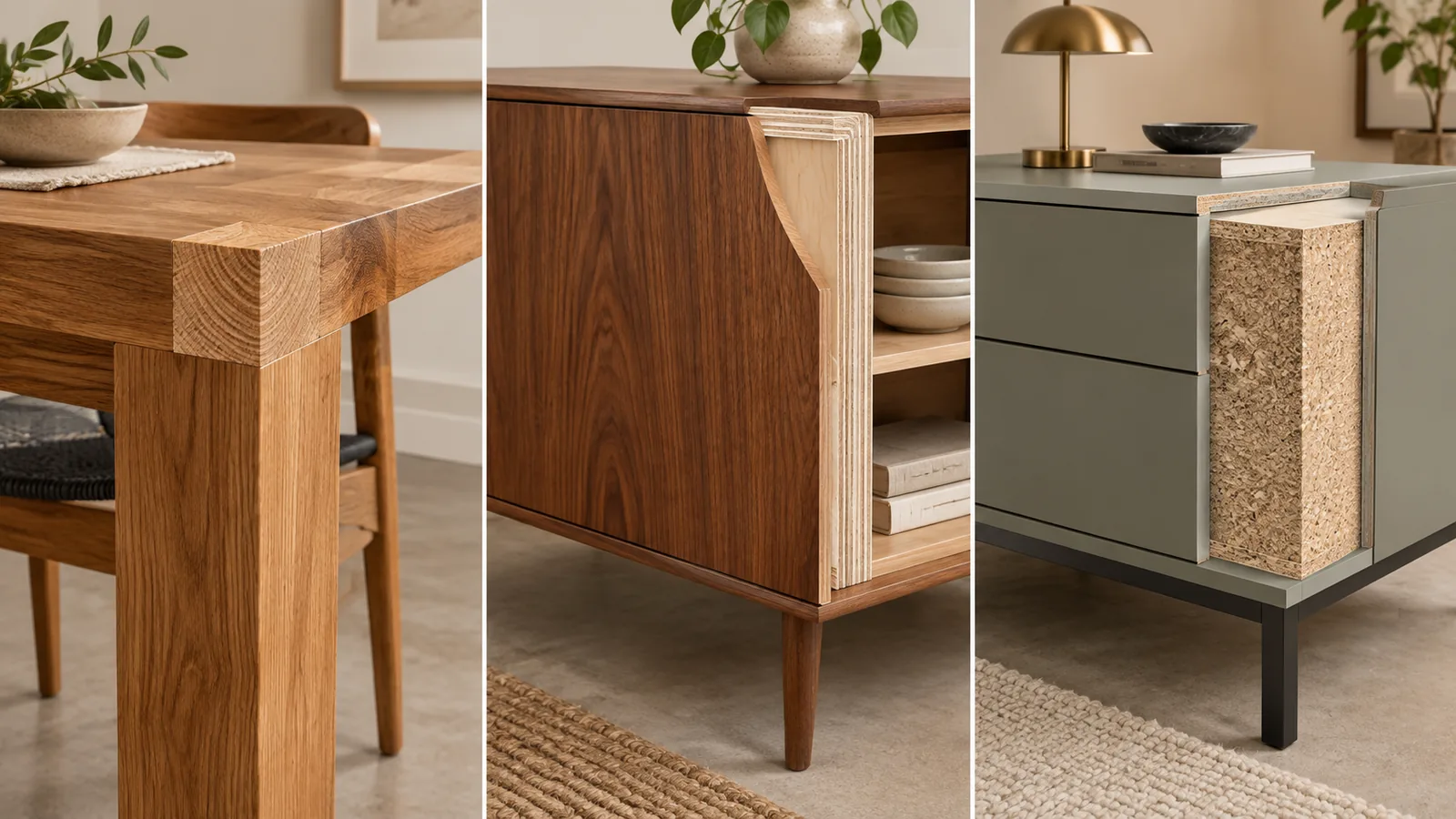
- ASolid wood: the same lumber through the full thickness, so it can be sanded and refinished repeatedly. It also moves with humidity.
- BVeneer over plywood: a thin real-wood face over a cross-laminated core. Stable across wide panels and entirely legitimate construction.
- CVeneer over MDF: a real-wood face over a dense fibre core. Smooth and flat, but damaged edges and water are hard to recover from.
- DLaminate over particleboard: a printed or plastic face, not wood at all, over a particle core. The weakest for fasteners and moisture.
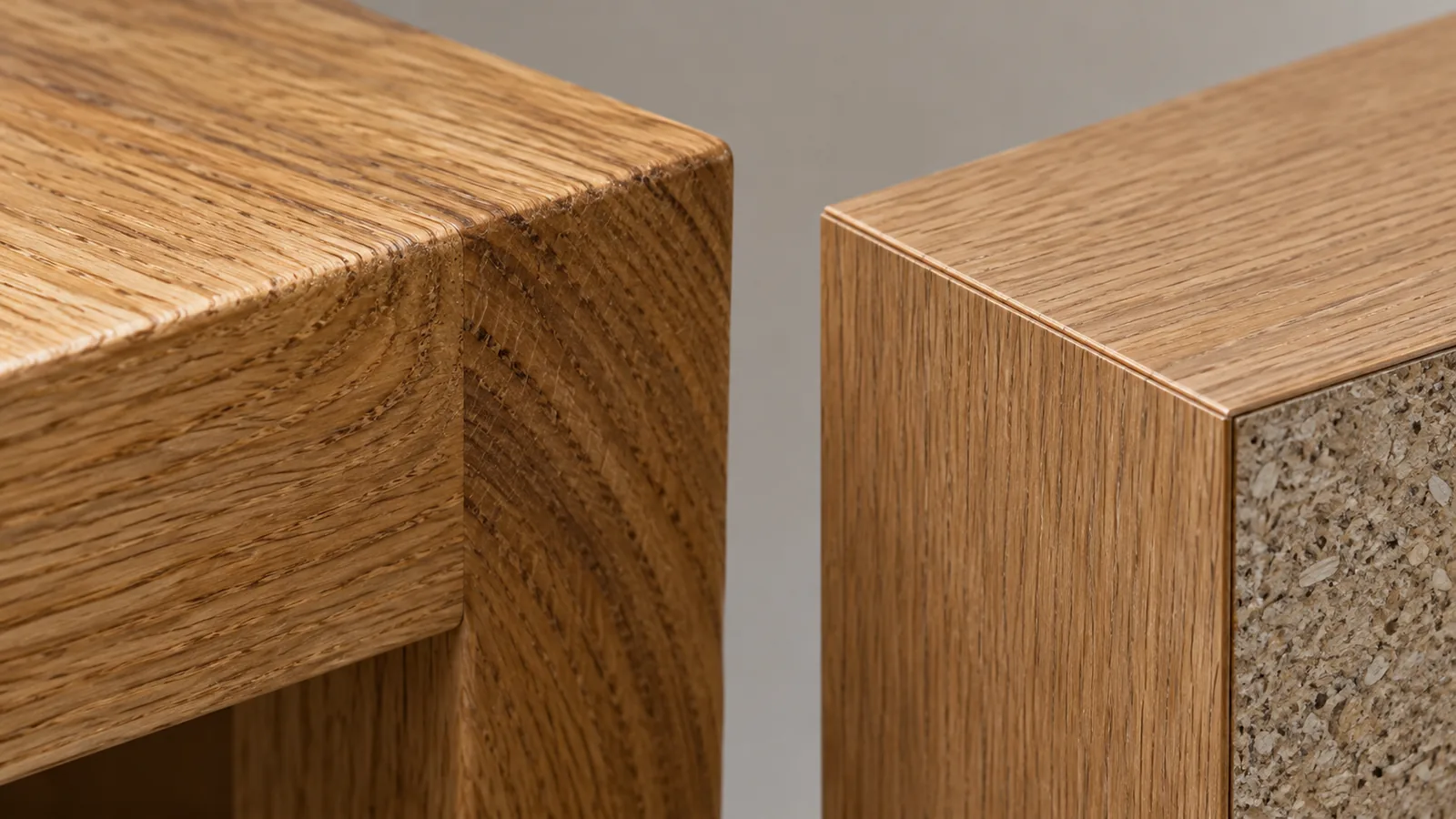
- Solid wood: natural lumber through the thickness of the named component. A dresser may have solid-wood legs and drawer fronts but a plywood back.
- Wood veneer: a thin layer of real wood bonded to a core. The U.S. Forest Products Laboratory describes decorative furniture veneer as roughly 0.20 to 1.7 mm thick. Thickness and substrate affect how much damage can be repaired.
- Plywood: wood veneers laminated in alternating grain directions. The Forest Products Laboratory notes that this construction gives plywood strong dimensional stability and more balanced strength across its width and length.
- MDF: wood fibres bonded into a smooth, dense panel. It takes paint and veneer well but damaged edges and wet areas are difficult to repair.
- Particleboard: wood particles bonded into a panel. Quality varies, but repeated disassembly, water exposure, and overloaded fasteners are common weak points.
- Laminate or foil: a printed paper or plastic surface. It can imitate wood grain but is not wood veneer.
For technical background, see the U.S. Forest Products Laboratory references on wood-based composites and veneered furniture surfaces.
Solid wood, veneer, and engineered wood compared
| Factor | Solid wood | Veneer over plywood | Veneer over MDF or particleboard |
|---|---|---|---|
| Repair depth | Usually best | Good for small surface repairs; sanding is limited | Limited once the face or edge is damaged |
| Dimensional stability | Moves across the grain with humidity | Usually strong for wide panels | Flat in normal indoor use; vulnerable if water reaches the core |
| Weight | Varies by species | Often lighter than MDF | MDF can be surprisingly heavy |
| Fasteners and moves | Can often be repaired or re-fastened | Good when edges and joints are properly designed | Repeated disassembly can weaken screw holes |
| Grain options | Limited by board width and available species | Excellent for matched grain and rare species | Excellent surface appearance at lower cost |
| Price | Usually highest | Middle to high | Usually lowest, with exceptions |
A quality veneered cabinet can outlast a poorly joined solid-wood one. Construction quality remains the deciding layer: joint design, panel thickness, edge protection, hardware, finish, and whether damaged parts can be replaced.
Where each material works best
A well-built case piece is usually mixed construction. Each part has a different job, and the right material follows the job rather than the marketing line.
- ATop: a broad flat surface. Veneer over plywood often stays flatter here than a wide solid panel, and a solid edge lipping protects it from knocks.
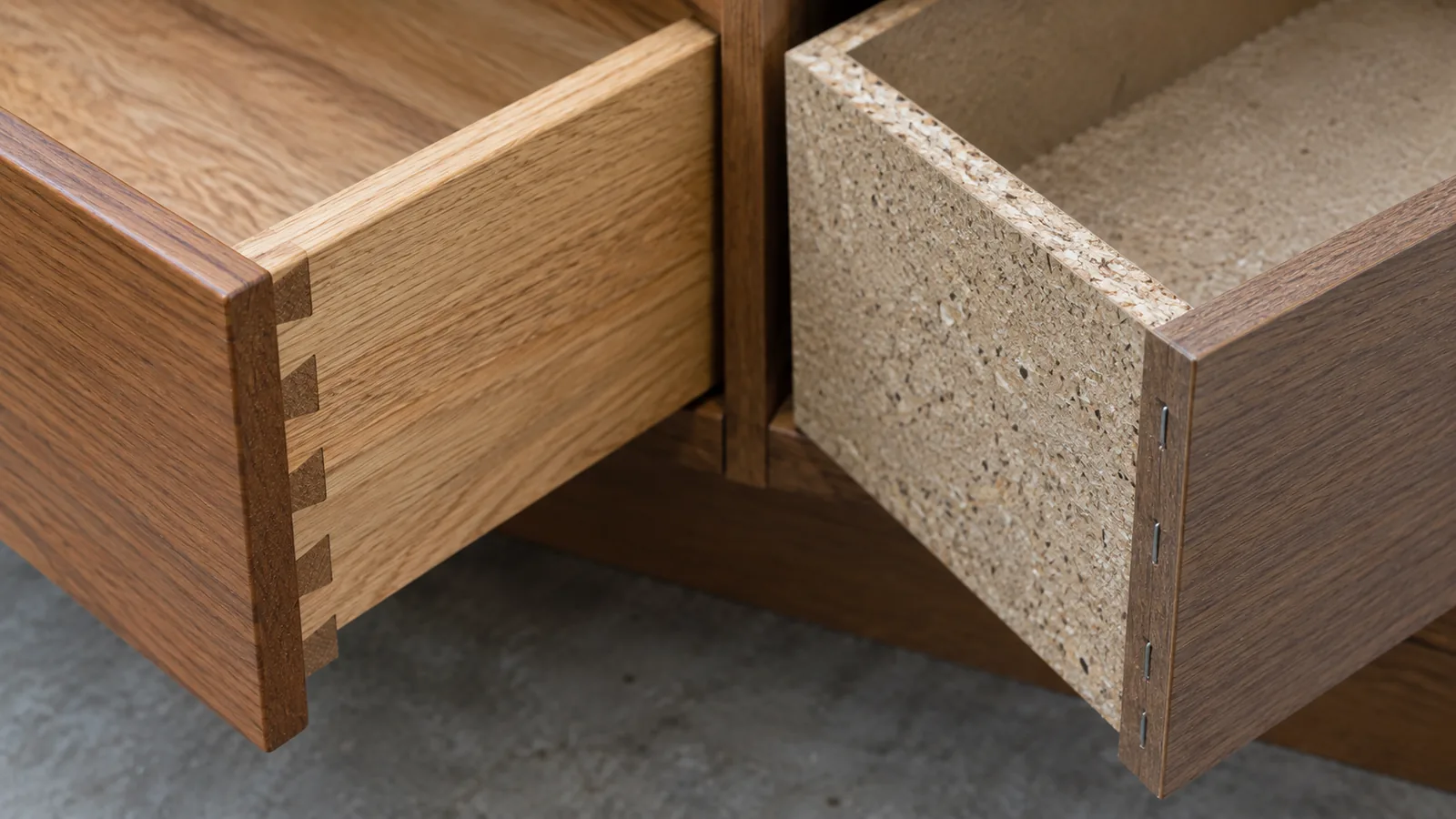
- BDrawer fronts: solid or veneered both work. What matters more is the drawer box behind, where you want solid or plywood sides and strong corner joints rather than stapled particleboard.
- CLegs, rails, and feet: the parts that take impacts and carry load. This is where solid wood earns its price.
- DSides and back: stable panels are normal and fine. A thin hardboard back stapled on is the budget version; a fitted plywood back is a better sign.
Dining tables and desks
Solid wood is attractive when repairability matters, but a wide top must be designed to move with humidity. Veneer over plywood can keep a large surface flatter. Check edges carefully: a solid lipping protects a veneered top better than an exposed thin edge.
Dressers and cabinets
A sensible mixed construction often uses solid wood for legs, rails, and drawer fronts; plywood or veneered panels for broad sides and backs; and engineered panels where a flat surface matters. “All solid wood” is not required for a durable case piece.
Bed frames and sofas
Focus on the load-bearing frame, centre supports, joints, and replaceable hardware. Decorative veneer on a headboard is less important than weak slats or undersized rails. Our bed frame guide covers slat spacing and what each frame type has to support. On a sofa, frame and suspension specifications matter more than a veneered decorative panel, and the cushion construction comparison explains the layer you actually sit on.
How to read a furniture listing
- Separate the parts. Ask what the top, legs, frame, drawer boxes, backs, and shelves are made from.
- Name the core. “Oak veneer” is incomplete. Oak veneer over what: plywood, MDF, particleboard, or solid wood?
- Look for load limits and panel thickness. These are more useful than weight alone.
- Inspect edges and undersides. Repeated grain, a thin edge line, or a different underside can reveal veneer. That is not a defect; it tells you how the piece is built.
- Ask about repairs. Can the top be refinished, hardware replaced, shelves reordered, or drawer slides adjusted?
- Do not use heaviness as proof. MDF and particleboard can be heavier than some solid woods.
The same habits help when you are chasing a cheaper version of an expensive piece. Our guide to finding furniture lookalikes covers the specifications that separate a good dupe from a bad one.
Oklahoma State University notes that high-quality veneer is used as a premium surface over both MDF and particleboard in furniture and cabinetry. The word veneer alone therefore does not establish quality. See its overview of wood composite substrates.
Why solid wood moves, and panels do not
Wood takes on moisture from the air and gives it back again. It swells and shrinks far more across the grain than along it, so a wide solid panel changes width with the seasons while its length stays put. This is normal behaviour in a healthy piece of furniture, not a defect, and good makers design for it.
That is also the honest argument for engineered panels. Plywood's alternating layers cancel most of that movement out, which is why a wide veneered top can stay flatter across a dry winter and a humid summer than the same top in solid lumber.
- Expect seasonal gaps. A solid tabletop or a panelled door may show a hairline gap in winter that closes in summer. A gap that keeps growing, or a top that has cupped, is a different problem.
- Look for movement designed in. Breadboard ends, floating panels inside frames, and slotted fastener holes all let solid wood move without splitting. Their absence on a wide solid panel is a warning.
- Keep furniture away from the extremes. Radiators, underfloor heating, fireplaces, and direct summer sun dry one face faster than the other, which is what actually warps a panel.
- Watch water on engineered cores. Solid wood survives a spill that will swell an MDF or particleboard edge permanently. Wipe spills quickly and seal cut edges, especially near sinks and windows.
Damage and repair, material by material
Repairability is where the materials genuinely differ, and it is the part listings never mention. The question is not whether a piece can be damaged, it is what happens next.
| Damage | Solid wood | Veneer | Laminate or particleboard |
|---|---|---|---|
| Surface scratch | Sand and refinish, repeatedly if needed | Light sanding only; the face layer is thin | Usually permanent; the printed layer cannot be restored |
| Dent | Often liftable with steam, then refinished | Steam risks lifting the veneer from its core | Permanent, and it may break the surface film |
| Water ring or spill | Refinishable, sometimes only locally | Repairable if caught early; standing water lifts glue | The core swells and stays swollen |
| Chipped edge | Fill, sand, and blend | Patchable by a restorer; edging can be replaced | Hard to disguise; the core is visible and soft |
| Loose or stripped screw | Plug and re-drill | Fine where screws land in a solid rail or plywood | Strips quickly, and repeated disassembly makes it worse |
| Change of colour or finish | Strip and refinish the whole piece | Possible on thicker veneer, risky on thin | Paint over it at best, after priming |
This is why mixed construction is so common in good furniture: solid wood on the parts that get hit, sanded, and screwed into, stable panels where a flat surface matters more than repairability.
Which should you buy?
- Want to refinish it repeatedly?Choose solid wood or a piece with a clearly stated thick veneer.
- Buying a broad tabletop or cabinet door?Quality veneer over plywood can be the more stable construction.
- Moving frequently?Prioritise robust connectors, replaceable hardware, protected edges, and manageable weight.
- Listing only says “engineered wood”?Ask for the substrate and construction before treating the price as good value.
The best answer is often mixed construction, with solid wood where joints and impacts matter and stable panels where broad flat surfaces matter. Buy the specification, not the slogan.