
Quick verdict
| Construction | Feel | Shape retention | Maintenance | Best for |
|---|---|---|---|---|
| Foam with fibre wrap | Medium to firm | Good when the foam is resilient and correctly sized | Low | A tidy look and predictable support |
| Spring core with foam | Buoyant and supportive | Very good in a well-built cushion | Low to medium | Daily use and people who dislike sinking |
| Foam with down or feather wrap | Soft surface over a supportive core | Core stays shaped; outer wrap wrinkles and shifts | Medium | Plush comfort without an all-down cushion |
| Mostly down or feather | Deep and enveloping | Relaxed, not crisp | High | People who accept fluffing for softness |
No cushion works independently. The frame and the seat suspension below it carry part of the load. A good cushion on stretched webbing can still feel saggy, while a firm suspension can make the same cushion feel more supportive.
What is actually inside a sofa cushion?
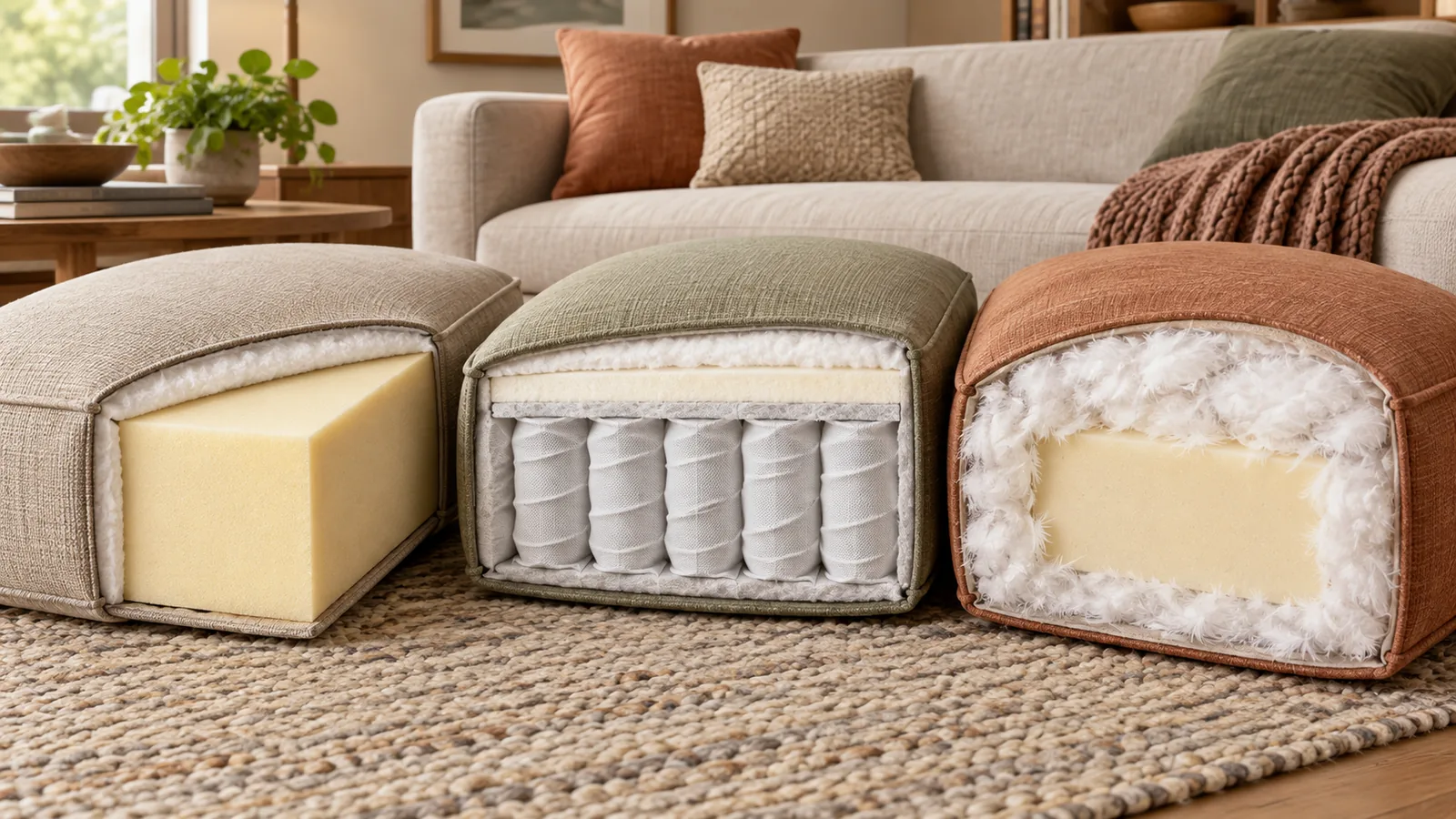
- AWrapped foam: a foam core inside a fibre jacket. Ask for the foam type and density, and whether the core can be replaced through a zip.
- BSpring core: small coils inside foam and padding. Ask about coil size and what surrounds them, because the foam still does much of the work.
- CDown wrapped: a foam or spring core inside a channelled jacket of down, feather, or fibre. The wrinkles are the product, not a fault.
- DThe suspension beneath, usually sinuous springs or webbing, is a separate system. A good cushion on tired webbing still feels saggy.
Foam cushions
Foam creates the shape and most of the resistance in mainstream sofa cushions. Density and firmness are different properties. Firmness describes how hard the first sit feels. Density describes how much material is present in a given volume and is one useful indicator of durability within the same foam family.
A fibre wrap softens the edges and prevents the cover from reading like a bare rectangular block. Higher-resilience foams can recover more quickly after compression, but labels vary. Ask for the foam type and density rather than relying on “high density” as a marketing phrase.
- Advantages: predictable support, tidy shape, low maintenance, and straightforward replacement when the cover has a zip.
- Tradeoffs: low-quality or undersized foam softens; very firm foam can feel unforgiving; some cushions cannot be flipped.
Spring-core cushions
A spring-core cushion places small coils inside a foam and padding envelope. It is different from the sofa suspension beneath the cushions. The coils carry part of the sitter's weight, creating a buoyant response and reducing how much work the surrounding foam must do.
Spring construction is not automatically premium. Coil size, padding, foam quality, and assembly still matter. Room & Board, for example, describes one of its spring-and-down builds as encased coils surrounded by high-resiliency foam, then wrapped in fibre, feather, and down. Its comfort guide also shows that spring constructions can be tuned from soft to firm.
- Advantages: supportive feel, good recovery, and less dependence on one thick foam block.
- Tradeoffs: higher price, more complex construction, and a firmer or bouncier feel that not everyone likes.
Down, feather, and down-wrapped cushions
True all-down seating is uncommon in ordinary sofas because it compresses and moves. More often, a foam or spring core sits inside a channelled jacket filled with feathers, down, fibre, or a blend. The core supplies support; the jacket creates the soft surface.
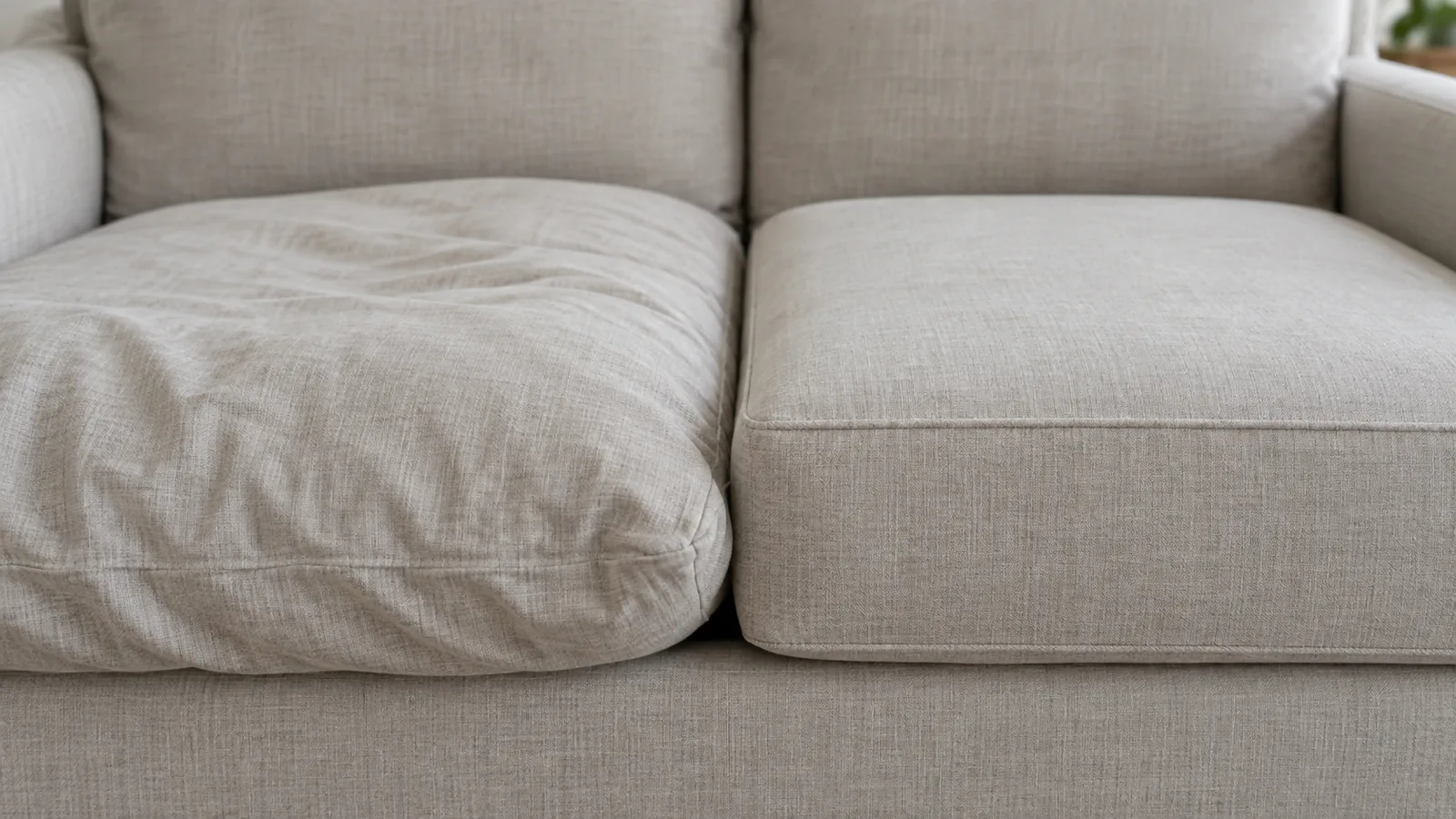
The relaxed wrinkles are part of the product, not necessarily a failure. If you want a crisp, showroom-straight cushion every day, a thick down wrap is the wrong specification. If you want a soft seat and accept rotating and fluffing, it may be exactly right.
- Advantages: plush first contact, an enveloping feel, and an intentionally relaxed appearance.
- Tradeoffs: migration, “puddling” in the cover, regular fluffing, and possible feather leakage through a poor ticking.
Feel and upkeep at a glance
Comfort and maintenance pull in opposite directions. The softer the surface, the more often someone has to reshape it. This is our assessment of where the four common builds sit, not a laboratory measurement.
Specifications to request before buying
- The layer-by-layer build: core, wrap, ticking, and cover.
- Foam type and density: not only “firm,” “premium,” or “high density.”
- Whether coils are inside the cushion: and whether the sofa also has a separate spring suspension.
- Whether cushions are removable, reversible, and replaceable: these features can extend useful life.
- Care requirements: how often the maker recommends rotating or fluffing.
- Warranty coverage: check whether normal softening is excluded and whether replacement cores are available.
Do not judge by cushion construction alone. The existing sofa repair-or-replace guide explains how cushions, suspension, and frame fail differently. The cover matters for upkeep too: our leather vs fabric comparison covers durability and cleaning, and the fabric couch cleaning guide explains the W, S, W/S, and X codes before you test anything on a cushion.
How to test a cushion in ten minutes
Showrooms are built for first impressions, and a first impression is the least reliable thing about a cushion. Sitting down for five seconds tells you about the top inch of padding. These checks tell you about the rest.
- Sit for at least five minutes. Most cushions feel supportive at first. What matters is whether you are still level, or slowly sinking, when the novelty wears off.
- Sit where you actually sit. If you always take the end seat with an arm behind you, test that one. Corner seats and end seats wear differently.
- Sit on the front edge. A weak front edge collapses under the part of the cushion you use every time you stand up. This is where cheap foam gives itself away.
- Watch the recovery. Press the centre firmly, release, and count. Quick, even recovery is what resilient foam and coil cores are for. A slow dent that stays is the beginning of a permanent one.
- Check the depth against your legs. Sit back fully. If your feet leave the floor or your lower back has no contact, the seat is too deep for you, whatever it is filled with. Our sofa size guide has seat depths by height.
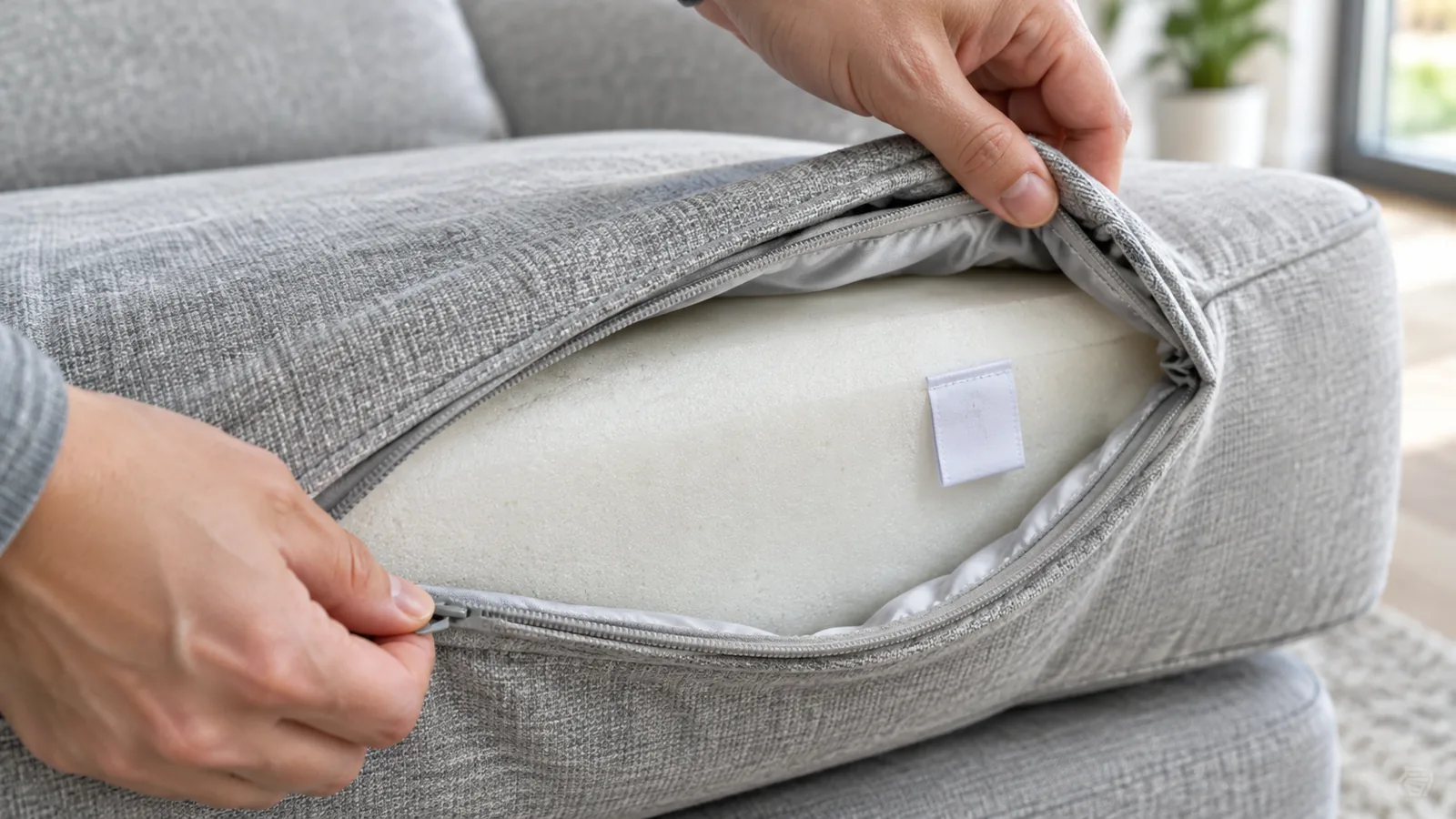
- Ask to unzip it. A retailer who will not show you the core, or cannot say what it is, has answered a different question than the one you asked.
How cushions fail, and what the fix costs
Cushion problems are usually repairable, and much cheaper to fix than the sofa they sit on. The trick is identifying which layer actually failed, because the cushion often gets blamed for the suspension underneath it.
| What you notice | Usual cause | Realistic fix |
|---|---|---|
| You sink, and the seat does not bounce back | Foam fatigue, or a core that was undersized from the start | A replacement core through the existing zip, usually without touching the upholstery |
| The cushion creeps forward or puddles in its cover | Fill migrating inside an oversized cover, common with down wraps | Reshape and rotate regularly; ask about a firmer core or a fibre wrap |
| One seat is visibly worse than the others | The seat somebody uses every night | Rotate and flip if the cushions are reversible; replace that single core if not |
| Everything feels saggy but the cushions look fine | Stretched webbing or tired springs beneath the cushions | Re-webbing or spring repair by an upholsterer, not new cushions |
| Creaks, pops, or grinding when you sit | The frame or suspension, again not the cushion | Have the frame joints and suspension inspected before spending anything on foam |
| Relaxed wrinkles on a down-wrapped seat | Nothing; this is how the construction behaves | Fluff and rotate; if it bothers you, the specification was wrong rather than faulty |
Before paying for new cores, work out whether the sofa is worth the investment at all. Our repair-or-replace checklist covers the frame, suspension, and upholstery together.
Which cushion should you choose?
- Want a tidy sofa with little maintenance?Choose resilient foam with a fibre wrap.
- Want support without a hard block feel?Try a well-padded spring-core cushion in person.
- Want the softest, sink-in surface?Choose a down or feather wrap and accept regular fluffing.
- Household members differ in height or mobility?Prioritise moderate depth and supportive recovery over maximum softness.
- Retailer will not disclose the construction?Treat the upgrade language as unverified and compare another model.
The best cushion is the one whose feel, maintenance, and replaceability suit your household. A softer showroom sit is not automatically a better long-term seat.