
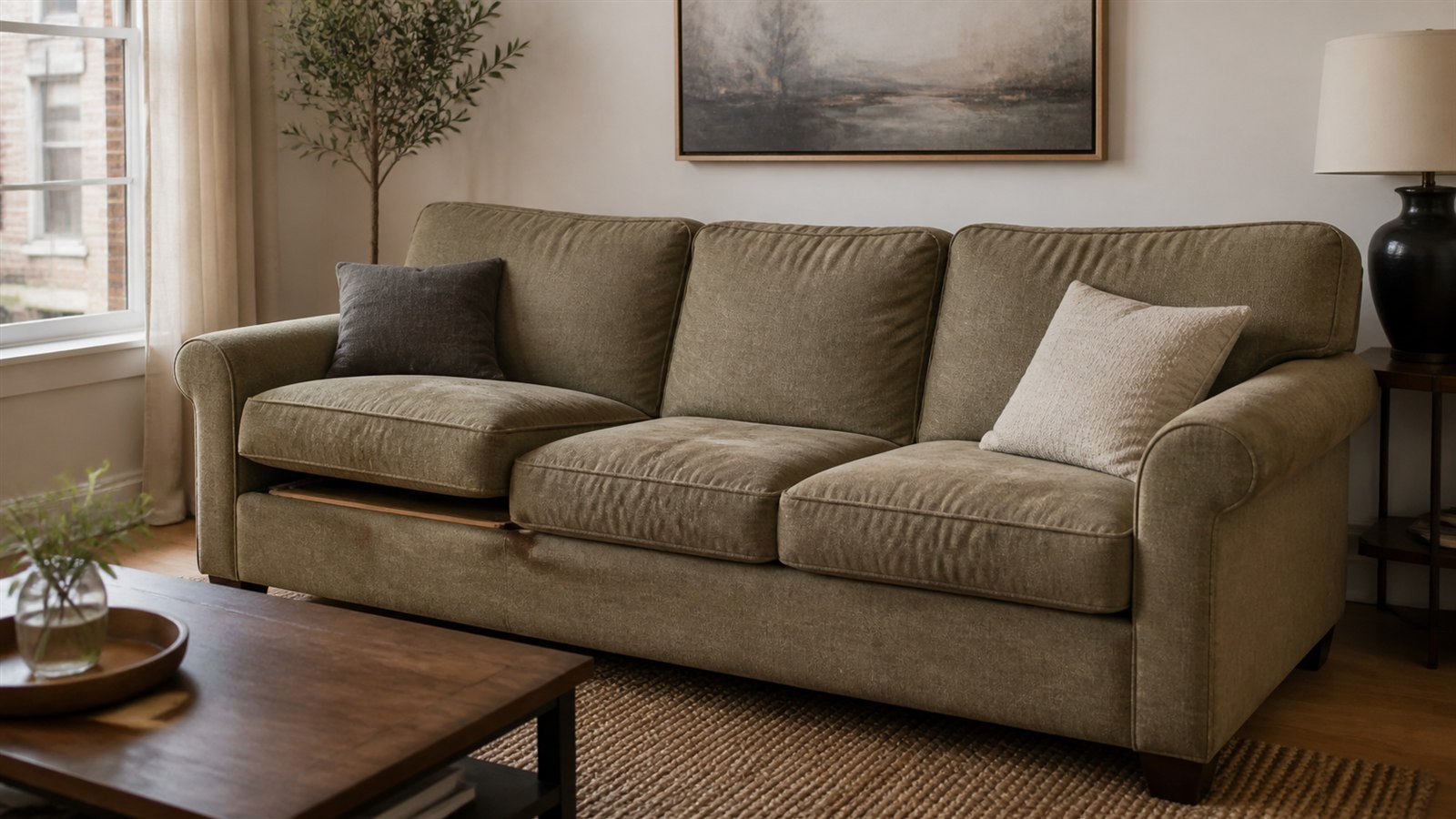
How long should a sofa last?
Most furniture guides put the average sofa lifespan somewhere around 7 to 15 years. That range is useful for planning, but far too broad to make the decision for you. A lightly used hardwood-frame sofa with replaceable cushions may outlast it. A low-cost sofa used every day by a busy household may lose support much sooner.
Four things usually determine the real lifespan:
- Frame construction. The frame is the sofa's skeleton. Loose joints, split rails, or a frame that has twisted out of square are more consequential than cosmetic wear.
- Seat support. Springs, webbing, clips, and the deck under the cushions carry the load. A sofa can have plump-looking cushions and still sag because the support beneath them has failed.
- Cushion filling. Foam softens, fibre compacts, and feather fillings migrate. Removable cushions can often be refilled without replacing the sofa.
- Use and care. Daily use, favourite-seat habits, pets, children, sunlight, humidity, and cleaning all change how quickly a sofa ages.
So use age as a prompt to inspect, not as a countdown. If a ten-year-old sofa is supportive, stable, clean, and still fits the room, there is no practical reason to replace it.
7 signs it may be time to replace your sofa
1. You cannot sit comfortably for a normal evening
The clearest warning sign is not how the sofa looks but how your body feels after using it. If you slide toward the middle, struggle to stand, feel a hard rail through the seat, or need to rearrange cushions constantly, the seat is no longer doing its job.
First remove and swap the cushions. If the problem follows one cushion, replacement foam or filling may solve it. If every cushion sinks into the same low point, the fault is probably in the suspension or frame below.
2. The frame moves, leans, or is no longer square
Stand back and compare the arms, back, and front rail. One corner sitting lower than the others, an arm that moves when pushed, or a gap that opens and closes as someone sits suggests loose or damaged structure. A single loose joint may be repairable. Several moving joints, cracked timber, or a twisted flat-pack frame make replacement more likely.
A creak alone is not a verdict: dry joints and loose fasteners can be noisy without being dangerous. A creak paired with movement, a sudden drop, or visible cracking deserves prompt inspection.
3. The springs or webbing have failed
Remove the seat cushions and press along the deck. It should resist evenly. A hammock-like dip, a spring you can feel through the covering, or a sharp wire pushing upward means the support system needs attention. Stop using any seat where metal has broken through fabric.
Spring and webbing repairs are standard upholstery work, but access often requires removing fabric from the underside or front of the sofa. Ask for a quote before assuming it is either a five-minute fix or a total loss.
4. The upholstery is beyond a local repair
Fading and a few stains are aesthetic problems. Splitting leather, fabric worn thin across several panels, failing seams throughout the sofa, or pet damage that has reached the padding is a larger job. A cleaner, slipcover, or replacement cushion cover can rescue local wear; widespread damage usually means full recovering or replacement.
If the frame is excellent, worn fabric may actually be the best case for reupholstery. If both the covering and the structure are failing, paying to put new fabric over weak foundations rarely makes sense.
5. Odour, damp, or contamination keeps returning
Surface smells often respond to vacuuming and cleaning that is appropriate for the care code. Persistent smoke, urine, or damp odours can sit deep in foam and batting. Visible mould, a known pest infestation, sewage exposure, or flood contamination calls for professional advice; cleaning the visible cover may not reach the affected material.
Do not unzip covers or apply water until you have checked the manufacturer's care instructions. Wet cleaning the wrong textile or saturating the filling can make a manageable problem worse.
6. The sofa no longer fits the household or room
A sofa can be physically sound and functionally finished. Perhaps a deep, low seat has become difficult for someone with limited mobility. Maybe a sectional blocks the only good traffic route after a move, or a two-seater no longer accommodates the household. Those are legitimate replacement reasons.
Before blaming style alone, test the layout. Moving the sofa away from the wall, removing a chaise module, or changing the surrounding rug and tables can make a familiar piece work again. Our room-layout guide gives the clearances to check.
7. Repairs are becoming frequent and cumulative
One repair can extend a sofa's life. A sequence of cushion replacement, spring repair, seam repair, and then frame work is a different calculation. Add the quotes for all known work rather than authorising each job in isolation.
Replacement is usually the cleaner decision when the frame, support, and upholstery are all failing; the sofa has no special quality or sentimental value; and the total repair cost approaches the price of a better-suited replacement. Compare like with like. A quote for skilled reupholstery should not be judged only against the cheapest new sofa available.
A 10-minute sofa inspection
- Photograph the sofa from the front. A picture makes leaning arms, uneven seat lines, and a sagging middle easier to notice.
- Sit in every position. Compare the favourite seat with the least-used one. A large difference often points to cushion or local suspension wear.
- Swap removable cushions. Rotate them front-to-back and move them between seats. Note whether the low spot moves.
- Press the bare seat deck. Feel for even resistance, detached webbing, sharp springs, or a central dip.
- Push each arm and the back. They should not rock independently of the base. Listen, but pay more attention to movement than noise.
- Look underneath. With help, tilt the sofa safely and inspect the dust cover for protruding springs, cracked rails, loose legs, or torn fabric. Do not crawl under an unsupported sofa.
- Smell close to the cushions and base. This distinguishes a room odour from one held inside the upholstery.
- Check the label and model details. They can help you order cushions or parts and may be needed if you later donate the sofa.
Repair or replace? Use the failing part to decide
| What you find | Usually try first | Replacement becomes more likely when… |
|---|---|---|
| One flat removable cushion | Rotate, refill, or replace the foam | All seats also sag into a failed deck |
| Local stain or odour | Care-code-safe professional cleaning | Contamination has reached foam or keeps returning |
| Small seam split or one worn panel | Upholstery repair or a fitted cover | Fabric is brittle or worn across most panels |
| Detached spring or stretched webbing | Quote from an upholsterer | The frame is also cracked or twisted |
| Loose joint or leg | Structural furniture repair | Several joints and rails are failing |
| Strong frame, dated fabric | Reupholster or use a quality slipcover | The quote exceeds your budget and there is no sentimental or design value |
| Wrong size or seat shape | Test a different layout | Clearances, access, or users' comfort still do not work |
When is reupholstery worth it?
Reupholstery makes the strongest case when the sofa has a sturdy, repairable frame; a shape or size that is difficult to replace; sentimental or collectible value; and upholstery or filling as the main problem. It makes a weaker case for a mass-market sofa with a damaged composite frame and several failing systems.
Ask an upholsterer to distinguish recovering from reupholstering. Recovering changes the outer fabric. Full reupholstery can include stripping the piece, repairing joints, replacing webbing or springs, rebuilding padding, and applying new fabric. Quotes differ because the jobs differ.
Before deciding, get an itemised quote that names the structural work, filling, fabric quantity, labour, collection, and delivery. If possible, compare two quotes and ask what will remain original.
Before buying the next sofa
If replacement wins, avoid turning urgency into another poor fit. Record what failed on the old sofa and use it as the brief for the next one.
- Measure the room, route through the home, doorways, turns, and lift, not just the wall where the sofa will sit.
- Choose seat height and depth for the people who use it most. Feet should reach the floor unless a deep lounge posture is intentional.
- Ask what the frame, suspension, and cushion cores are made from, whether cushions can be replaced, and what the structural warranty actually covers. Compare the comfort and upkeep tradeoffs in our foam, spring, and down sofa cushion guide.
- Look for removable or reversible cushions where practical, and check cleaning codes before choosing a pale or highly textured fabric.
- Mark the footprint with painter's tape, then preview shortlisted sofas in your own room. Tape checks clearance; a visual preview checks bulk, colour, and proportion.
How to move the old sofa on responsibly
If the sofa is clean, safe, and still usable, sell or donate it rather than treating it as waste. Describe wear honestly and keep the permanent safety labels attached. In the UK, reuse organisations generally require the correct fire-safety label on upholstered furniture; local rules and charity acceptance criteria vary. Hampshire County Council recommends keeping the label to maximise reuse potential, while North London Waste Authority advises checking local donation and bulky-collection options.
If it is unsafe, contaminated, or beyond reuse, book the appropriate bulky-waste or recycling service. Do not leave it on the street or dismantle upholstered furniture without checking local guidance. The best ending for an old sofa is reuse when it is genuinely fit for another home, with proper handling when it is not.