
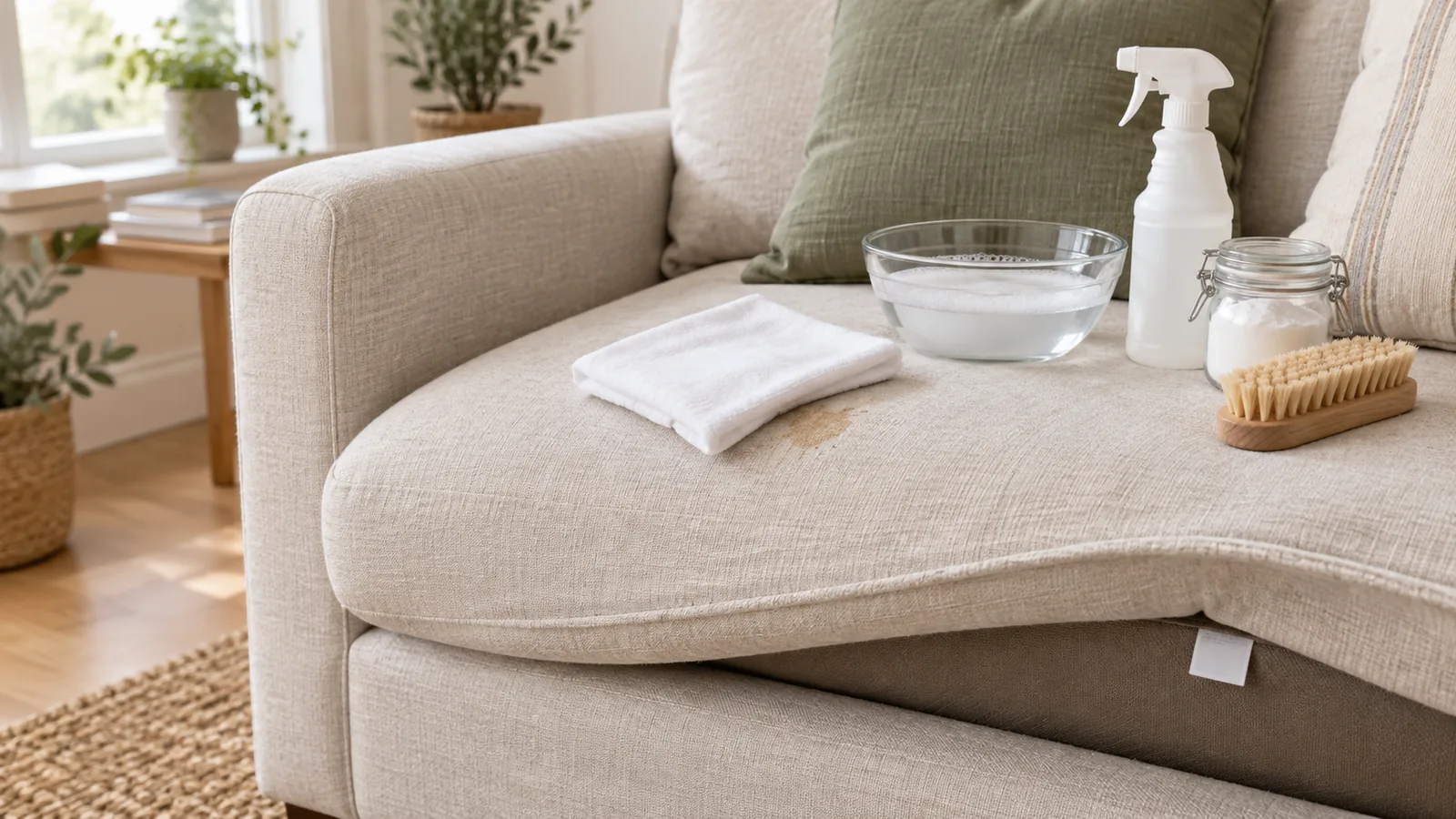
Step one: find your couch's cleaning code
Most upholstered furniture from mainstream makers carries a cleaning code: a letter or pair of letters telling you which kind of cleaner the fabric can tolerate. Look for it on a tag under the seat cushions, on the underside of the frame, on the care card that arrived with the sofa, or on the fabric page of the retailer's website. The code matters more than the fibre content, because it reflects how the face fabric, its backing, and any finishes behave together.
| Code | What it means | Safe to use | Avoid |
|---|---|---|---|
| W | Water-based cleaners only | Mild dish-soap solution, water-based upholstery shampoo, foam cleaners | Dry-cleaning solvents |
| S | Solvent-based cleaners only | Water-free dry-cleaning solvent or a solvent spot remover, in a ventilated room | Water, steam, and anything water-based |
| W/S (or SW) | Water or solvent cleaners | Start with the mildest water-based option; switch to solvent for oily stains | Oversaturating the fabric |
| X | Vacuum or light brushing only | Vacuuming and a soft brush; professional advice for stains | Any liquid cleaner, water or solvent |
These definitions match the ones published by textile maker De Leo Textiles and furniture retailer Room & Board. Professional upholstery cleaners will ask for the code before they quote, so it is worth photographing the tag now.
If you cannot find a code, treat the fabric as S or X until you know otherwise: vacuum, blot spills dry, and contact the retailer or manufacturer with the model name. Some performance and outdoor fabrics are labelled bleach-cleanable, which is a separate, stronger instruction. Only use bleach when the maker explicitly says the fabric can take it.
Routine care that prevents most deep cleans
The cheapest couch clean is the one you never need. Dust and grit act like fine sandpaper every time someone sits down, and Room & Board notes that they make fabric wear faster. A few habits keep a sofa out of deep-clean territory for much longer:
- Vacuum regularly with an upholstery attachment, and run the crevice tool along seams and under the cushions, where crumbs and pet hair collect.
- Flip, rotate, and fluff removable cushions so no single seat takes all the wear. Feather and down cushions need fluffing often to restore their loft.
- Keep the sofa out of direct sunlight where you can. Dark fabrics and natural fibres such as cotton fade fastest.
- Blot spills the moment they happen with a clean, dry, white cloth. A fresh spill is far easier to lift than one that has dried into the fibres.
- Give pets their own throw on their favourite seat. Washing a blanket is easier than cleaning an arm.
How to deep clean a W or W/S fabric couch, step by step
This method suits fabric coded W or W/S. Set aside an afternoon; the cleaning itself is quick, and most of the time is drying.
- Vacuum every surface. Take off loose cushions and vacuum the deck, the seams, the arms, the back, and both sides of each cushion. Cleaning over grit turns it into mud.
- Confirm the code. Only continue with this water-based method if the tag says W or W/S.
- Test in a hidden spot. Try your solution on the back or underside of the couch, let it dry fully, and check for colour change, a ring, or a change in texture. Do not skip this: dyes and finishes vary even within one code.
- Mix a mild solution. A few drops of clear, mild dish soap in a cup of warm water is enough. More soap does not clean better; it leaves residue that attracts dirt.
- Apply with a damp cloth, not a spray. Dampen a clean white cloth and work in small sections. The goal is to clean the face of the fabric without soaking the backing or the foam beneath.
- Blot from the outside in. Press and lift, working from the outer edge of a mark towards its centre so you do not spread it. Turn the cloth to a clean area as dirt transfers.
- Rinse with distilled water. Blot with a cloth dampened in distilled water to lift soap residue. Room & Board recommends distilled water because the minerals in tap water can stain or discolour fabric.
- Dry quickly, then brush. Use a fan or open windows and keep heaters and hair dryers away. Once the fabric is completely dry, brush the pile gently in one direction.
For S-coded fabric, the shape of the job is the same, but swap the soap solution for a water-free solvent spot cleaner, skip the water rinse entirely, ventilate the room well, and keep flames and heat sources away. For X-coded fabric, stop at step one and call a professional for anything a vacuum and soft brush cannot handle.
DIY couch cleaners compared
Cleaning advice online tends to treat a few household ingredients as universal. They are not. The table compares the common options by the job they do well, the codes they suit, and how much can go wrong. The risk rating is our editorial judgement based on how each ingredient behaves on upholstery; your own test patch is always the final word.
| Cleaner | Best for | Codes | Risk to fabric | Verdict |
|---|---|---|---|---|
| Mild dish soap and warm water | General grime, food, body oil on arms and seat fronts | W, W/S | Low | The best first try |
| Baking soda (dry) | Odours | W, S, W/S | Low | Freshens; does not remove stains |
| Diluted white vinegar | Odours, soap residue, some water-based stains | W, W/S after testing | Medium | Useful, but can affect some dyes |
| Isopropyl (rubbing) alcohol | Ink, marker, general cleaning of synthetic microfibre | S, W/S after testing | Medium | Effective on polyester microfibre; flammable |
| Solvent spot remover | Grease, makeup, oily stains | S, W/S | Medium | The correct tool for S fabric |
| Enzyme cleaner | Urine, vomit, food proteins | W, W/S | Low to medium | Best choice for pet accidents |
| Hydrogen peroxide | Organic stains on white fabric | W, whites only after testing | High | Can lighten dyes; last resort |
| Diluted bleach | Stains on bleach-cleanable fabric | Bleach-cleanable only | High on anything else | Follow the maker's ratio exactly |
| Steam or hot-water extractor | Whole-sofa refresh | W only | Medium to high | Light passes only; overwetting is the usual failure |
Mild dish soap and water: the one to try first
It is gentle, cheap, and matched to what actually soils a couch: skin oils, food, and general grime. Its only real failure mode is using too much of it. A heavy soap solution leaves a sticky film that attracts new dirt, which is why the distilled-water rinse matters.
Baking soda: a deodoriser, not a stain remover
Sprinkle a light, even layer over dry fabric, leave it for at least 20 minutes (longer for strong smells), then vacuum it out thoroughly, including the seams. It absorbs odours well. It does little for visible stains, and a paste of baking soda and water adds exactly the moisture you are trying to avoid. On X-coded fabric, stick to the vacuum.
White vinegar: good for odours, handle with care
A mix of roughly one part white vinegar to three parts water helps with lingering smells and soap residue on W fabric. Its acidity can shift some dyes, so test first, and expect a vinegar smell until the fabric dries. Never combine vinegar with bleach.
Rubbing alcohol: the microfibre favourite
Many polyester microfibre sofas are coded S, and isopropyl alcohol is a solvent that evaporates quickly without leaving water rings. Dab it on with a white cloth or cotton swab, blot, then brush the fibres once dry to soften them. It is flammable, so ventilate the room and keep it away from heat. Test it anyway: not every S fabric is microfibre, and not every dye tolerates alcohol.
Enzyme cleaners: for anything a pet or person left behind
Urine, vomit, and food proteins need enzymes to break them down; ordinary soap mostly moves them around. Follow the product's dwell time, blot rather than scrub, and use the smallest effective amount. If the smell returns after the fabric dries, the problem is in the cushion filling rather than on the surface.
How to remove common couch stains
Whatever the stain, start the same way: lift off any solids with a spoon or dull knife, then blot up as much liquid as you can with a dry white cloth before you add any cleaner.
| Stain | On W or W/S fabric | On S fabric |
|---|---|---|
| Coffee, tea, juice | Blot, then the soap solution and a distilled-water rinse | Solvent spot remover, sparingly |
| Red wine | Blot immediately; soap solution in small passes; call a professional for large spills | Blot, then a professional; water will ring |
| Grease, food oil, body oil | Soap solution (W); solvent spot remover (W/S) | Solvent spot remover |
| Ink or marker | Test, then dab with isopropyl alcohol on a cotton swab | Test, then dab with isopropyl alcohol |
| Pet urine | Blot hard, then an enzyme cleaner per the label | Blot, then a professional |
| Mud | Let it dry, brush and vacuum, then treat any residue | Let it dry, brush and vacuum |
| Water rings | Blend lightly with distilled water across the ring's edge | Solvent cleaner blended across the panel, or a professional |
Work patiently: several light applications, blotted between each, beat one heavy soak every time. If a stain has not moved after three or four passes, stop before you damage the fabric and get a professional opinion.
Can you machine-wash couch cushion covers?
Usually not, even when the covers have zips. Room & Board's guidance is direct: do not dry clean or machine wash cushion casings, because it may damage the fabric, backing, or stitching. Zips are often there so the cover can be fitted over the foam, not as an invitation to launder it. Washing can shrink a cover so it no longer fits its insert, strip a stain-resistant finish, and leave one cushion visibly brighter than its neighbours.
The exception is a cover whose care label or product page specifically says it is washable, which is common on slipcovered sofas. If yours qualifies:
- Wash every cover at the same time so they age and fade together.
- Close the zips, use the temperature and cycle on the label (usually cold and gentle), and skip fabric softener on performance fabrics unless the maker allows it.
- Air dry, or tumble on low only if the label permits. High heat is the usual cause of shrinkage.
What not to use on a fabric couch
- Too much water. Overwetting causes rings, can brown natural fibres such as cotton and linen as they dry, and leaves damp foam that smells later.
- Tap water on pale fabric. Minerals can leave marks as the water evaporates. Rinse with distilled water.
- Coloured cloths or printed paper towels. Dye can transfer onto damp upholstery. Use white cloths.
- Rubbing and hard scrubbing. It spreads the stain, distorts the pile, and can wear away stain-resistant finishes.
- Melamine sponges. "Magic eraser" sponges work by abrasion, which is exactly what fabric does not need.
- Bleach on fabric that is not labelled bleach-cleanable, including bleach-based sprays and toilet or bathroom cleaners.
- Mixed products. Never combine bleach with vinegar or ammonia; the mixtures release harmful gases.
- Steam on S or X fabric, and heat from hair dryers or heaters on any fabric while it dries. Heat can set stains and shrink fibres.
How often should you clean a couch?
| Task | How often | Notes |
|---|---|---|
| Vacuum | Weekly in a busy household; more with pets | Include seams and under the cushions |
| Flip and rotate cushions | Every couple of weeks | Evens out wear and fading |
| Spot clean | Immediately | Fresh spills are far easier to lift |
| Deep clean (W, W/S) | Once or twice a year, or when arms and seat fronts look dull | Always test first |
| Professional clean | About once a year | Room & Board recommends an annual professional cleaning |
When to call a professional, and when cleaning will not fix it
Call an upholstery cleaner for stains on X-coded fabric, for any stain on a fabric whose code you cannot find, for large or old stains, for water damage, and for urine or other contamination that has soaked into the cushions. Give them the cleaning code and the fabric name when you call.
Some problems are not cleaning problems at all. A seat that sags after you rotate the cushions, a frame that moves, springs you can feel, or a smell that lives inside the foam point to the structure or filling. Our guide on when to replace your sofa helps you decide between new cushion cores, repair, reupholstery, and replacement.
If you do end up shopping for a new couch, put cleanability on the brief: check the cleaning code before you fall for a pale or textured fabric, look for removable and reversible cushions, and compare fabric durability ratings (our furniture dupes guide explains rub counts). Then preview your shortlist in your own room so the colour you can clean is also a colour you like.