
Quick verdict
Choose engineered quartz if
- You want no sealing and the least routine care
- You want the pattern in the showroom sample to match the kitchen
- You will use trivets every time, without exception
Choose granite if
- You cook hot and fast and want a surface that tolerates heat
- You want natural stone at the lowest price
- You accept sealing on lighter, more porous slabs
Choose quartzite if
- You want a marble look that does not etch with kitchen acids
- You will test the actual slab, not trust the label
- You have budget for harder, slower fabrication
The three countertops at a glance
Our assessment for typical slabs, built from the sources linked in each section. Real quartzite here means stone that passes the tests below; a mislabelled marble behaves like marble.
| Factor | Engineered quartz | Granite | Quartzite |
|---|---|---|---|
| What it is | Crushed quartz bound with resin and pigment | Natural igneous stone, mostly feldspar and quartz | Natural metamorphic stone, almost all quartz |
| Heat | Weakest: resin can scorch; thermal shock | Good; trivets still advised | Good; trivets still advised |
| Stains | Best: nonporous | Varies with porosity and sealing | Varies; some are porous |
| Etching from kitchen acids | Resists | Does not etch | Does not etch |
| Sealing | Never | Most slabs | Porous slabs |
| Pattern | Consistent, repeatable | Every slab differs | Every slab differs |
| Outdoors | Not standard lines | Possible; check absorption | Possible; check absorption |
| Installed per sq ft | $50 to $200 | $80 to $150 | $65 to $150 |
What each material is
Engineered quartz is made in a factory from ground quartz, polymer resin and pigments. The resin is what makes it nonporous, and also what makes it sensitive to heat and sunlight. Granite, in the Natural Stone Institute's words, is mostly feldspar when you look at a typical slab, with quartz and darker minerals mixed in; its porosity varies a lot from one stone to the next. Quartzite is sandstone that has been buried, heated and squeezed until its quartz grains fused into a dense rock; the NSI's guide to quartzite calls it a stone with very consistent properties but variable labelling.
Hardness explains most of the behaviour, and it is measured on the Mohs scale, which ranks minerals by what scratches what.
The values: calcite 3, dolomite 3.5 to 4, steel knife blade 5 to 6.5, feldspar 6 to 6.5 and quartz 7, from Geology.com's Mohs table; the NSI's mineral guide gives the same figures for quartz, feldspar and calcite (and 3.5 for dolomite), and notes that feldspar is harder than glass and calcite softer. Engineered quartz is not on the chart because it is a composite: its quartz is hard, but its resin is what reacts to heat.
Is it really quartzite?
This is the biggest practical risk in the category. The NSI says marble and dolomitic marble are often labelled as quartzite, that Super White is most commonly dolomitic marble, and that there is no such thing as "soft quartzite": a stone sold that way is most likely marble. The country of origin, price and trade name are not reliable clues, and in many cases you cannot tell the stones apart by eye.
Geologist Karin Kirk's stone sleuth tests for the NSI need a glass tile, a pocketknife and a lemon, and the seller's permission:
- Glass test. Press a sharp, broken edge of a sample into a glass tile and drag it firmly. Real quartzite bites in with a grinding sound and leaves a scratch you can feel. A softer stone glides and leaves a powdery trail that rubs off. If the stone has several colours or minerals, test each.
- Knife test. Drag a knife point across the slab. Quartzite is scratched lightly or not at all; marble and dolomite scratch easily. A silvery line that wipes off is metal from the blade, not a scratch.
- Etch test. Leave a few drops of lemon juice or vinegar on the surface for 5 to 10 minutes, wipe, and look at a low angle. A dull spot means calcite or dolomite. Quartzite shows no etch at all from kitchen acids. Sealer does not change the result.
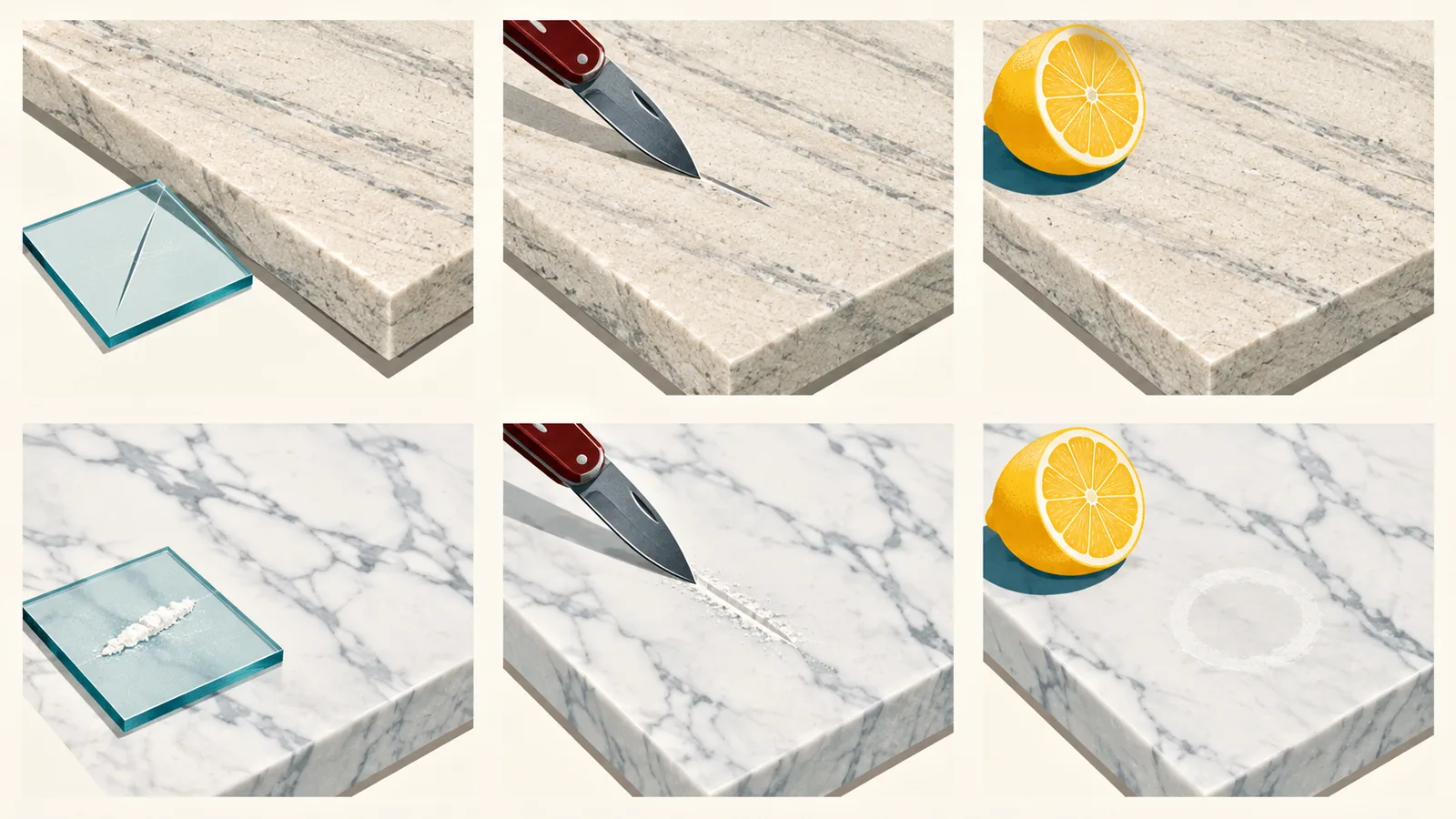
Two caveats from the same sources. Some marbles carry pockets of quartz, so test in several places; and strong acids, such as rust stain removers, can etch even granite and quartzite. The tests are about everyday kitchen acids and a quick hardness check, not a lab analysis.
Heat, stains, etching, and chips
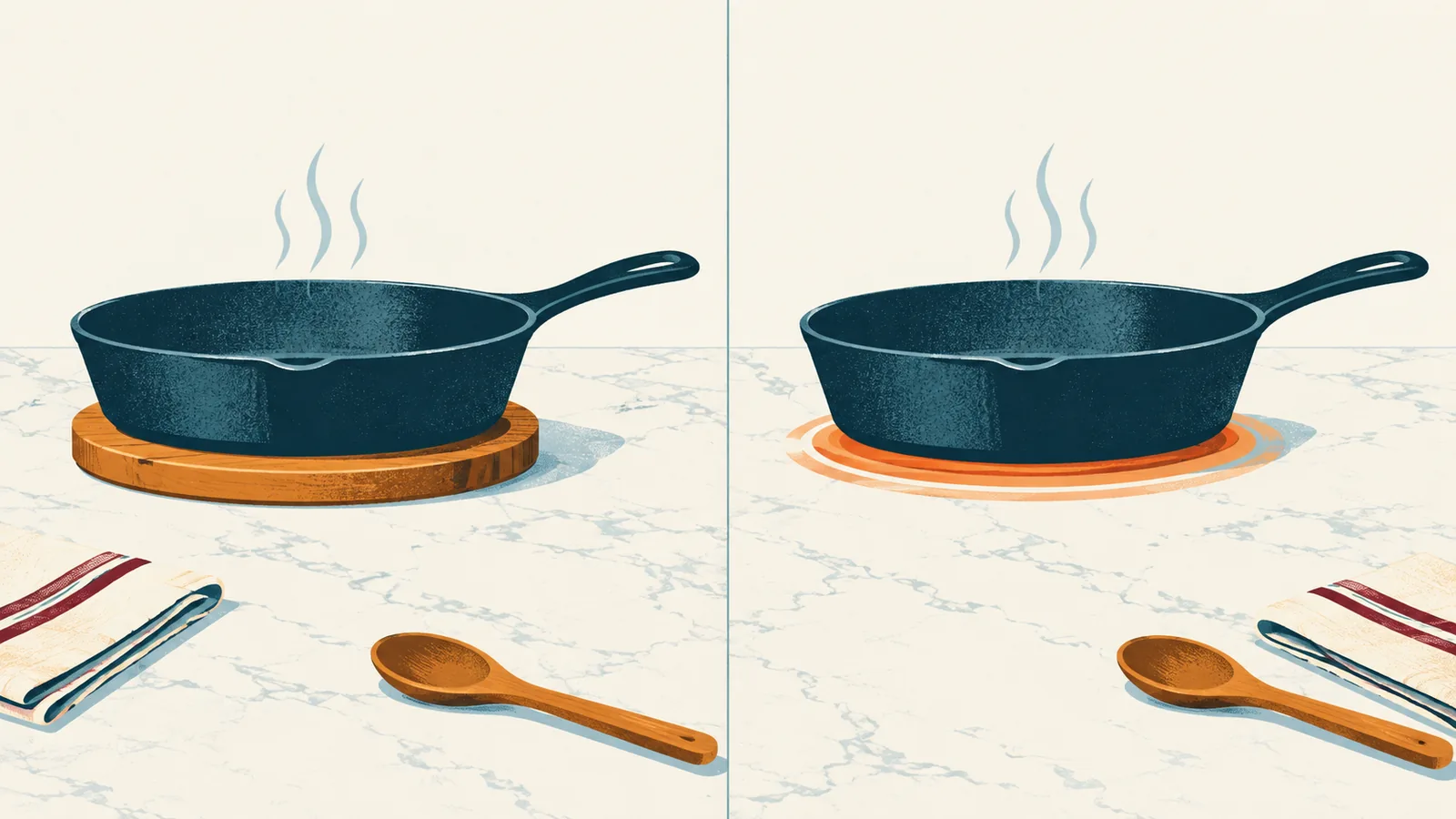
Heat. Caesarstone's residential limited warranty (June 2025) excludes damage from "flames or excessive heat" and explains that thermal shock can occur when a hot pan or dish is left on the countertop for more than a brief period; it says trivets or hot pads should always be used. Its care page repeats the trivet rule. The NSI, a natural stone trade body, says granite and quartzite generally tolerate heat well, while quartz resins may be sensitive to sustained high temperatures; it still recommends trivets on granite.
Stains. Engineered quartz is nonporous, so oil and wine stay on the surface. Natural stone ranges from almost impervious to thirsty: the NSI's granite care guide says some granites, such as Absolute Black, may not need sealing, while others may need four to six applications. Quartzites vary too; the NSI names White Macaubas as a porous variety that benefits from sealing.
Etching is a chemical dulling from acids, not a stain. Granite and real quartzite do not etch from kitchen acids; marble and dolomitic marble do. That is why the label matters so much. Chips: all three can chip at edges and around sinks. Caesarstone's warranty excludes chips and impact damage, and an NSI comparison argues that resin makes quartz chips harder to repair invisibly than stone. When you test a stone sample, also watch whether grains pop out or edges flake.
Sealing and everyday care
| Task | Engineered quartz | Granite | Quartzite |
|---|---|---|---|
| Daily cleaning | Warm water and mild detergent; wipe spills before they dry | Mild cleanser, water and a soft cloth | Same as granite |
| Sealing | Never; stone sealers, toners and cleaners can void the Caesarstone warranty | Penetrating sealer on most slabs; dense dark stones may not need it | Porous varieties need sealing, including all worked edges |
| When to reseal | Not applicable | When hot water left for 10 to 20 minutes darkens the stone | Same test; watch for darkening around the sink |
| Heat | Trivet or hot pad, always | Trivets and cooling racks advised | Trivets advised |
| Acids and chemicals | Avoid strong acids, alkalis, oven cleaners and solvents | Kitchen acids do not etch it; rust removers can | Kitchen acids do not etch it; rust removers can |
| Cutting | Cutting board; scratch resistant, not scratch proof | Cutting board | Cutting board; it can dull knives |
Sources: Caesarstone care and maintenance and warranty; the NSI's guides to granite care and quartzite care, which say a good sealer can last for years and that the sink area is the first place to watch. HomeGuide prices professional granite sealing at $200 to $350 per treatment; many owners do it themselves with an impregnating sealer.
Seams, slab sizes, and thickness
A countertop longer than the slab needs a seam. Caesarstone lists its standard slab at 120 x 56.5 in (305 x 144 cm) and jumbo slabs at up to 131.5 x 64.5 in (334 x 164 cm). Natural slabs vary block by block; HomeGuide describes quartzite slabs as roughly 120 x 77 in. Caesarstone also gives 25.5 in (65 cm) as the standard countertop depth, so two counter strips fit across one slab's width. The plan shows what that means in an example L-shaped kitchen.
- ACorner seam. Piece 1 runs the full 108 in (274 cm) along the left wall, including the corner square.
- BPiece 2 is the rest of the long wall: 156 minus 25.5 = 130.5 in (331 cm). It fits within a 131.5 in jumbo slab with an inch to spare.
- CFrom a 120 in standard slab, piece 2 is 10.5 in too long, so a second seam is needed somewhere along this wall. Where it goes is a layout decision for the fabricator.
- DSink cutout. As a rule of thumb, seams are kept clear of cutouts, which limits where a second seam can go.
- Countertop pieces, 25.5 in deep
- Standard slab outline, same scale
- Extra seam needed with a standard slab
Thickness: Caesarstone sells 12 mm, 2 cm (about 3/4 in) and 3 cm (about 1 1/4 in) slabs. HomeGuide notes that most stone slabs thinner than 3 cm need a plywood subtop under them to prevent cracking, and its quartzite guide describes 3 cm as the standard counter thickness. Ask the fabricator which thickness they recommend for any overhang; our counter vs bar stool guide covers the seating side of an island overhang.
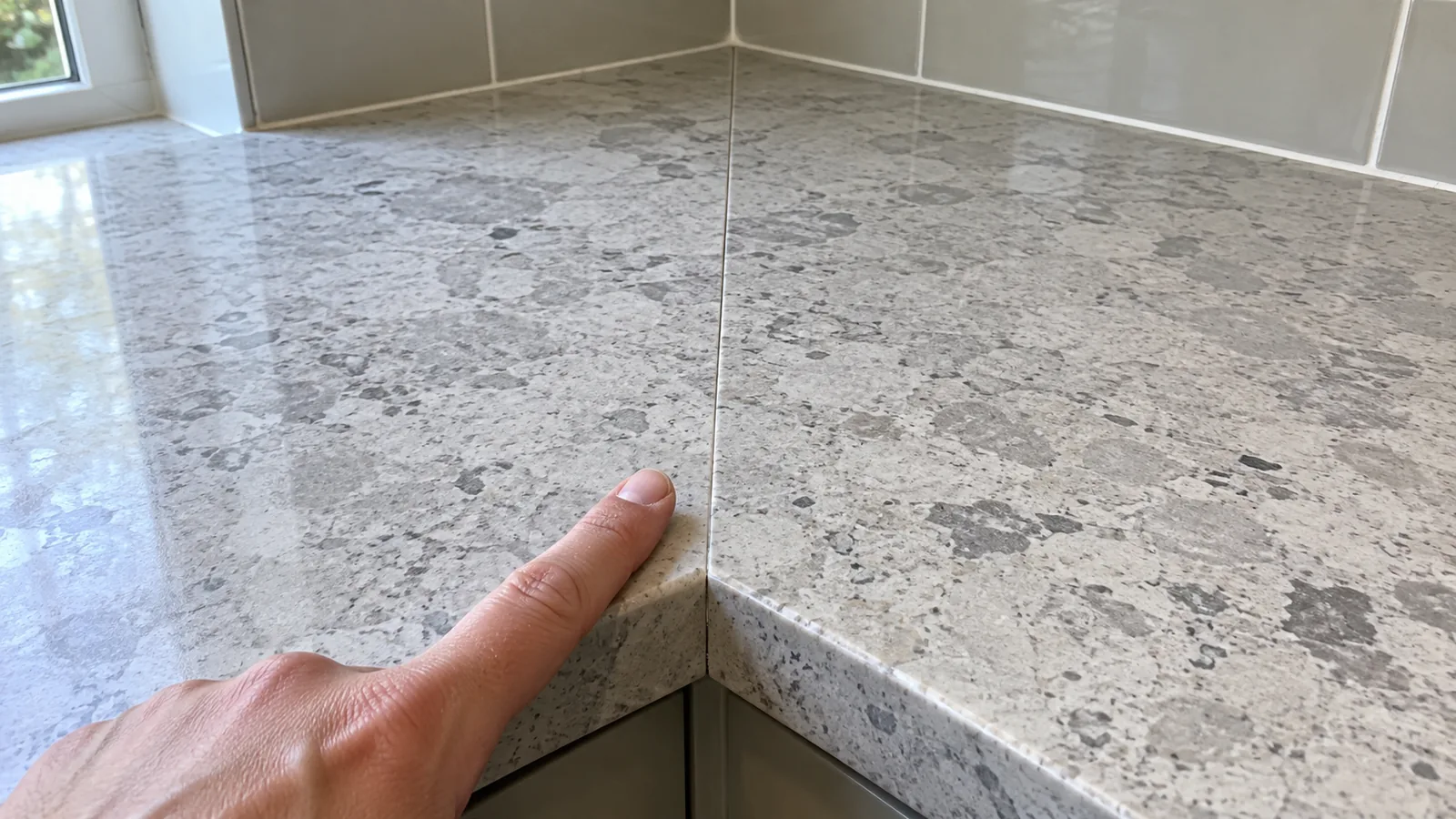
Caesarstone's warranty treats seam appearance as outside its cover and names cabinet movement and thermal shock as the two main causes of seams separating or cracking after installation.
Look, pattern, and outdoor use
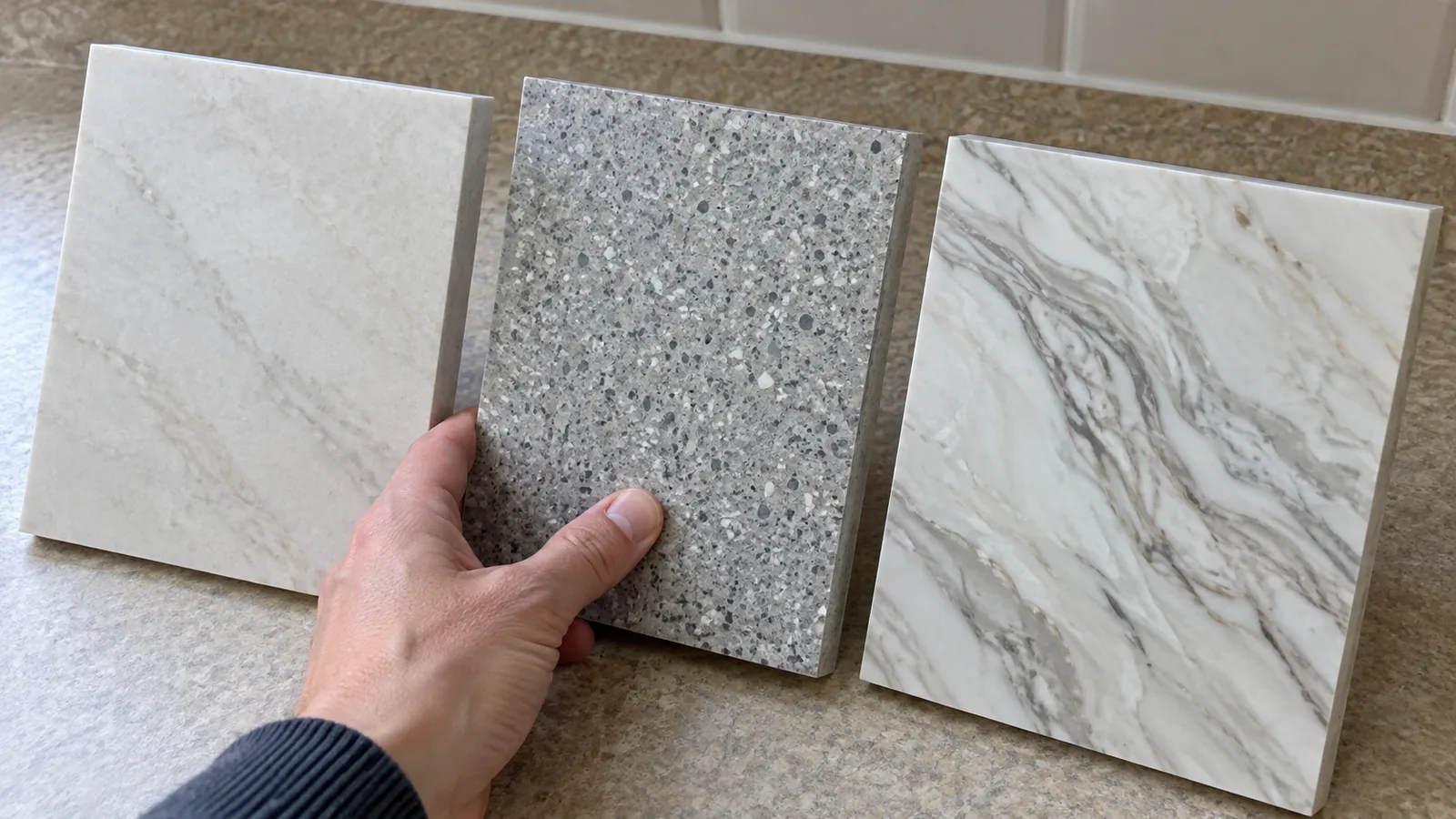
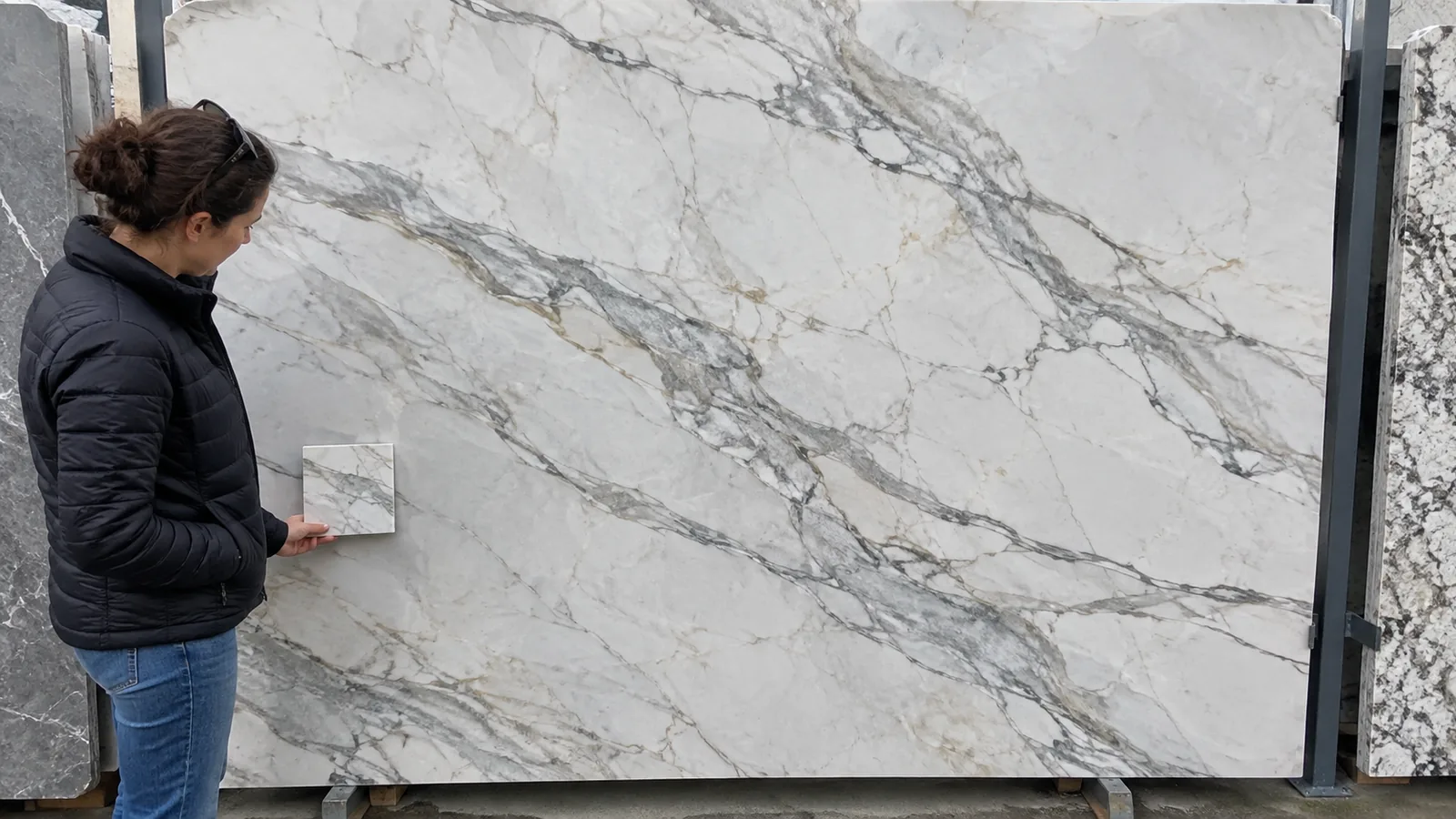
Engineered quartz is the one you can choose from a sample, because the pattern is made to repeat; long veins on marble-look quartz still need matching across seams. Granite and quartzite are one of a kind: the sample is a hint, and the slab is the product, so see and reserve the actual slabs.
Outdoors, standard engineered quartz is a poor bet. Caesarstone's residential warranty excludes outdoor installations and points to its separate Outdoor Collection, and Cosentino's Silestone residential warranty lists exposure to ultraviolet light and weather as abnormal use and says it does not cover outdoor uses. For natural stone outdoors, the NSI's performance guide (June 2026) points to water absorption: lower absorption means better stain resistance and freeze-thaw durability. Ask for that figure.
Installed cost
| Material | HomeGuide, installed per sq ft | HomeGuide, 30 to 40 sq ft kitchen | Fixr, installed per sq ft |
|---|---|---|---|
| Engineered quartz | $50 to $200 | $1,500 to $8,000 | $50 to $200+ |
| Granite | $80 to $150 (from $50 to $250+) | $2,400 to $6,000 | Material only quoted |
| Quartzite | $65 to $150 | $1,950 to $6,000 | $80 to $210 |
Sources: HomeGuide's quartz, granite and quartzite cost guides (bylines dated 2023 on pages titled 2026), and Fixr's quartz (updated January 2026) and quartzite (updated August 2025) guides. All checked in October 2026. HomeGuide puts Caesarstone at $50 to $100 and Cambria at $60 to $125 per sq ft installed. Treat these as national ranges and get quotes that list the slab, edge, cutouts, seams and removal of the old top.
Quartzite tends to cost more to fabricate than its slab price suggests: the NSI notes that its hardness slows cutting and wears tooling, so expect to pay a little more for fabrication.
Silica dust and fabrication safety
This is a hazard for the people who cut and finish countertops, not for people using a finished one. An OSHA and NIOSH hazard alert (2026) says workers who manufacture, finish and install natural and engineered stone countertops can be exposed to respirable crystalline silica, which can cause silicosis, an incurable lung disease. It gives typical crystalline silica contents of less than 0.2 to 95% for engineered stone, 95% or more for quartzite, 10 to 50% for granite and under 5% for marble and limestone, and says the hazard can be reduced in most operations with dust controls such as water and local exhaust, following the OSHA silica standard.
| Where | What the source says |
|---|---|
| United States (OSHA and NIOSH) | Silica exposure is a hazard in countertop fabrication shops and during on-site finishing, for natural and engineered stone alike; employers must control dust under the silica standard |
| Australia (from 1 July 2024) | A national ban on the manufacture, supply, processing and installation of engineered stone benchtops, panels and slabs, after Safe Work Australia advice about rising silicosis in engineered stone workers |
| Installed engineered stone in Australia | Can be used safely while undisturbed; there is no requirement to remove it; removal, repair or modification is what can release dust |
The Australian points are from the South Australian government's engineered stone ban page. What this means for you: ask your fabricator how they cut, for example whether they use wet methods, and do not cut, grind or drill any stone countertop yourself.
How to check a slab before you buy
- Get the material in writing. Quartz brand and colour, or the stone's type and trade name. A name is not proof of what the stone is.
- Test anything sold as quartzite with the glass, knife and lemon tests above, on a sample or offcut, in several spots.
- Test porosity. Leave water on an unsealed sample for about 15 minutes, wipe it, wait 10 minutes and look for a dark patch.
- See the whole slab in daylight. Look for cracks, filled pits and resin repairs; the NSI notes epoxy fill can pass for quartz at a glance.
- Reserve the slabs and ask for a layout showing every piece, seam and cutout on the actual slab, including vein direction.
- Confirm thickness and support: 2 cm or 3 cm, any plywood subtop, and the overhang support for an island.
- For quartz, check the warranty conditions. Caesarstone's requires a Caesarstone Certified Fabricator and proof of purchase.
- Ask about dust control in the shop and on site.
Take accurate measurements to the showroom; our review of the IKEA kitchen planner lists what to measure in a kitchen before any planning appointment.
Which countertop should you choose?
- Want no sealing and a predictable pattern?Engineered quartz, with trivets for every hot pan.
- Cook hot and want natural stone on a budget?Granite; test porosity and seal if it darkens.
- Want a marble look without etching?Quartzite that passes the glass and lemon tests.
- The slab fails the glass test?It is marble or dolomite. Buy it only if you accept etching.
- Outdoor kitchen?Low-absorption natural stone, or a product warranted for outdoor use.
- Long, seamless runs?Ask for jumbo slabs and a seam layout before you commit.
Next step: shortlist two materials, take the tests and a tape measure to the yard, and ask two fabricators for quotes with a seam layout. If the floor is being replaced too, our LVP vs laminate vs engineered hardwood comparison covers the kitchen floor.