

Renders, AI images, and photos
Not every image that was not taken with a camera is a problem. Large furniture retailers have used 3D renders for years, because it is cheaper than building a set and shooting every colour. A render starts from an accurate 3D model of a real product, so its proportions and details match what arrives. A generated image starts from a text prompt or another picture, and the model invents whatever details look plausible, whether or not they can be built.
| Photograph | 3D render | AI-generated image | |
|---|---|---|---|
| Made from | The real product | A measured 3D model of the product | A prompt or a reference image |
| Details consistent across angles | Yes | Yes | Often not |
| Proportions match the dimensions | Yes, allowing for lens distortion | Yes | Not guaranteed |
| Can show a product that does not exist | No | Rarely | Yes |
| A reason to walk away? | No | No | Not on its own; check the listing |
So the useful question is not "is this AI?" but "does this exact product exist, and will it arrive looking like this?" That is also why a seller using AI for a lifestyle scene around a real, well-documented product is less of a worry than a seller whose only images are generated.
What to zoom in on
Generated images are very good at the overall impression and still unreliable in the details, especially where objects meet, repeat, or carry text. Open the largest version of the image and look at these areas.
- AText and pictures in the scene: book spines, prints, labels, and signs that dissolve into squiggles or near-letters.
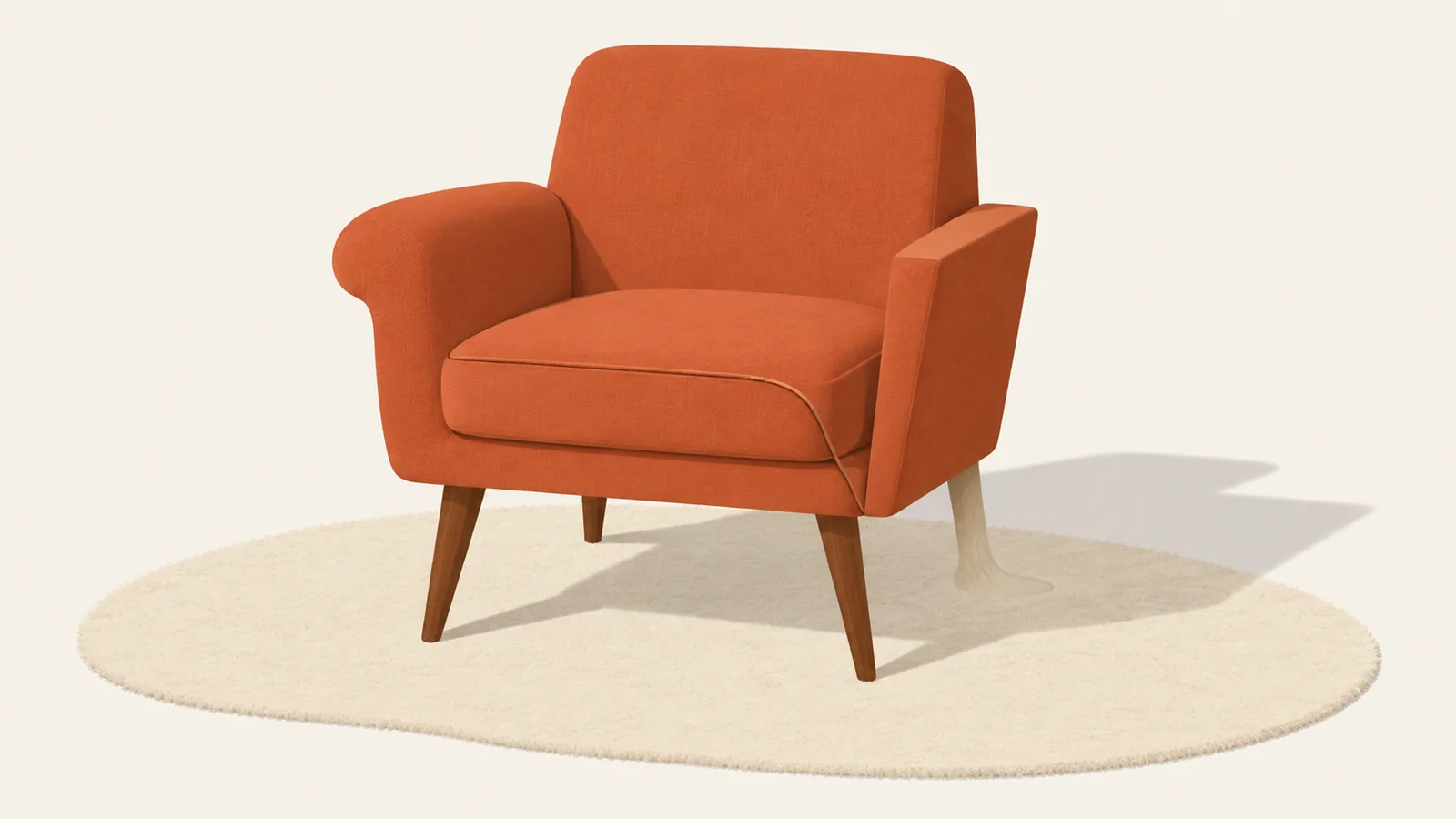
- BLegs and joints: the wrong number of legs, legs that do not reach the floor, or a leg that merges into the frame or the rug.
- CSeams, buttons, and pattern: stitching that wanders, buttons that change spacing, and a fabric pattern that does not repeat or bends oddly at a corner.
- DShadows and reflections: shadows that point different ways, or a reflection in the floor that does not match the object.
- EThe background: lamps, plants, and window frames that bend, melt into walls, or float.
- Symmetry that fails. Furniture is usually symmetrical. If the left arm of a sofa is a different shape from the right, or one side of a cabinet has more drawers, be suspicious.
- Construction that could not be built. A drawer with no visible way to open, a table leg with no joint, a shelf held up by nothing.
- Too perfect to be real. Glossy, glowing light with no dust, no creases, and no wear on anything, especially in a secondhand listing, is a warning in itself.
These signs are getting harder to see as the tools improve, and a heavily edited real photo can show some of them too. Treat them as reasons to check the listing, not as proof.
Red flags in the listing
The listing around the image usually tells you more than the image does. A seller with a real product can answer basic questions about it; a seller with only a picture cannot.
| Red flag | Why it matters |
|---|---|
| No dimensions, or dimensions that do not match the picture | A real product has been measured. A 60 in sofa that looks as long as a bed in the photo is a problem |
| Vague materials ("premium fabric", "quality wood") | Real listings name the fabric, frame, and filling; see how to read a furniture listing |
| Every photo is a styled scene; none shows the piece plainly | Plain shots from the front, side, and back are hard to fake consistently |
| No customer photos in the reviews | Buyers photograph what arrives. Their pictures are the best evidence you will get |
| A price far below similar pieces | A solid wood dining table or a full-grain leather sofa has a real minimum cost |
| A new store with one hit product and a countdown timer | Pressure tactics and no history are the pattern of drop-shipping and fake stores |
| No returns address, or returns only at your cost to overseas | If it does not match, you will not get your money back in practice |
Five checks before you pay
- Reverse image search the photos. Google Lens or a similar tool will show where else an image appears. A real product usually turns up on its maker's site and other retailers; a generated one turns up nowhere, or in listings for completely different products. Our guide to finding furniture from a picture covers the tools.
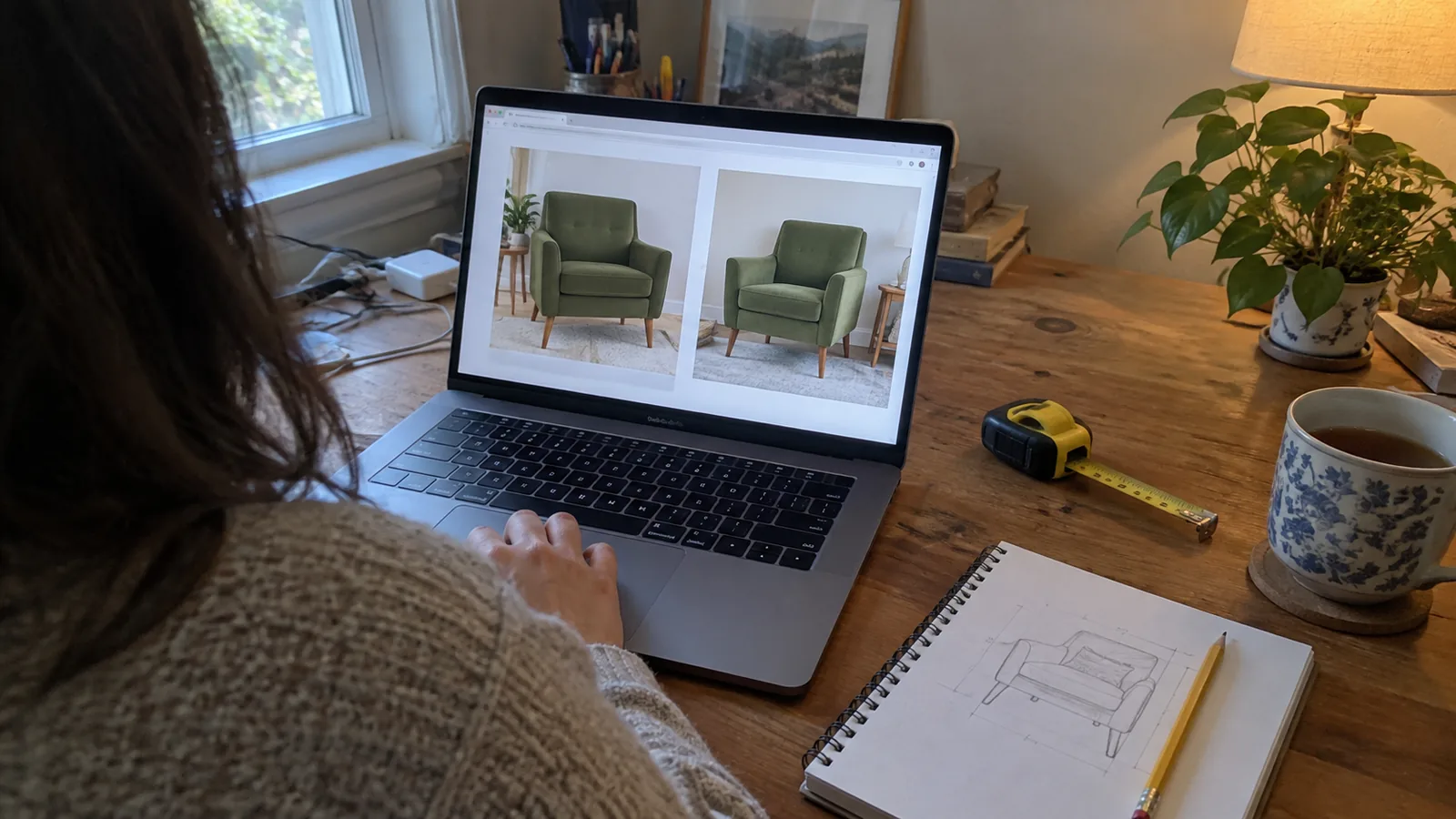
- Compare every photo of the item. Count the legs, buttons, and drawer handles in each shot. If they change, the images were not taken of one object.
- Ask the seller a specific question. For a marketplace listing, ask for one more photo showing the underside, a tag, or a tape measure along the front. A real seller can do it in a minute.
- Search for the product name plus "review". Real products leave traces: reviews with photos, forum threads, and videos. If you are chasing a look rather than a specific product, our guide to finding furniture lookalikes shows how to find a real piece with the same style.
- Pay with protection. Use a credit card or a payment method with buyer protection, never a bank transfer or gift card to a seller you do not know.
AI-written reviews
Fake reviews are easier to produce with AI too. In the US, the Federal Trade Commission's rule on consumer reviews, which took effect on October 21, 2024, bans businesses from creating, buying, or knowingly spreading reviews by people who do not exist, including AI-generated fake reviews. The rule gives the FTC a way to penalise the practice; it does not remove the reviews from the page in front of you.
Signs a set of reviews is not what it seems: many five-star reviews posted within a few days, reviews that repeat the product description, generic praise with no mention of size, colour, delivery, or assembly, and no photos. The most useful reviews are the three- and four-star ones with pictures, because they describe what arrived.
If you already ordered
- Keep everything: screenshots of the listing and every photo, the order confirmation, and all messages. Listings disappear quickly.
- Photograph what arrives next to the listing images, with a tape measure for scale, before you assemble or use it.
- Contact the seller in writing, then use the platform's resolution process or ask your card issuer about a chargeback if the item is not as described.
- Report it. In the US you can report a fraudulent seller to the FTC at ReportFraud.ftc.gov, as well as to the marketplace.
AI images are also useful in their proper place: exploring a style before you shop. Our guide to AI interior design styles covers that, and why nothing in a generated room is a product you can buy.