
Why it keeps happening
The scale problem is not a new phenomenon, but it has become more acute as online furniture retail has grown. When you bought furniture in a showroom, you could sit next to it, walk around it, and judge it against other known objects. Online, you have a flat image, dimensions listed as numbers, and your imagination filling in the rest.
The trouble is that the human brain is not particularly good at spatial reasoning from photographs. We judge scale relative to other objects, and product photography controls what those reference objects are. When a room is photographed to sell a sofa, every decision (the lens, the camera angle, the staging, the lighting) is made to make the sofa look appealing, not to help you judge its size in your specific room.
The result is a consistent class of surprises: the sofa that is far larger than expected, the dining table that looks elegant in the listing and imposing in the room, the rug that seemed generous and arrives looking like a bath mat.
How lens choice distorts scale
Lens choice is one of the largest technical factors in the scale problem. Interior photography often uses wide-angle or ultra-wide-angle lenses, commonly between 16mm and 35mm on a full-frame camera, because they can include more of the room from a practical shooting position.
Wide-angle lenses do two things that distort scale perception:
- They expand apparent room size. Objects in the foreground appear larger and those in the background appear smaller than in reality, exaggerating the perceived depth and width of a space.
- They make furniture appear smaller relative to the room. Because the room appears larger, the furniture within it appears more appropriately scaled, even when the reality is that the piece will dominate a normal-sized room.
You can sometimes detect an especially wide perspective by looking for objects near the frame edges that appear stretched, or for unusually dramatic size differences between foreground and background objects. Bowed architectural lines can indicate uncorrected barrel distortion, although professionally corrected images may keep those lines straight. The stronger the perspective effect, the less useful the photograph is as a scale reference.
The corrective habit: always read the dimensions in the listing rather than relying on visual judgment of the photograph. A sofa that looks appropriately sized in a wide-angle room photo may have a listed depth of 105 cm, which is substantial in a normal living room. Map those figures using the room-layout planning process before ordering.
Staging tactics that mislead
Beyond lens choice, the way a room is staged for photography systematically makes spaces look larger and pieces look better-proportioned than they will in your home.
Fewer pieces than a real room. Showroom and listing photography typically shows rooms with fewer objects than people actually live with. A sofa photographed with a single side table and a coffee table in an otherwise empty room looks vastly different from the same sofa surrounded by a bookcase, a TV unit, a drinks trolley, and the general accumulation of lived-in spaces.
Empty floors. Real rooms have rugs, toys, cables, bags, and shoes. Staging removes all of it. A clear floor expands the visual sense of space dramatically.
Mirrors and reflective surfaces. Mirrors in staging photography literally double the apparent size of a room. They appear frequently in listing photos for this reason.
Carefully chosen scale references. Staging teams select accompanying furniture to make the hero piece look its best. A sofa will be shown with a coffee table that is proportionally correct, not the randomly-sized table you already own. This makes the sofa look more harmonious than it may actually be in your room.
Ceiling height. Product photography favours high-ceilinged spaces. A wardrobe that looks elegant under a 3-metre ceiling may feel oppressive under a standard 2.4-metre one.
Colour under different light
Colour is where the photography gap is often most jarring, because it is deeply affected by lighting conditions and none of those conditions are yours.
Product photography uses controlled studio lighting: usually large, diffuse light sources that minimise shadows and render colours at their most neutral and appealing. Your room has a particular orientation (north-facing, east-facing), specific window sizes, and artificial lighting with its own colour temperature. A sofa that reads as warm taupe in a south-facing studio looks noticeably cooler and greyer under the tungsten light in a north-facing living room.
Fabrics and textures are especially affected. Bouclé, velvet, and linen look different in directional sunlight than in diffuse studio light. Dark colours absorb ambient light and can appear more intense in a real room. Light colours reflect surrounding surfaces. A cream sofa in a room with terracotta walls will pick up a pink cast your screen never suggested.
The best tool for colour evaluation is a physical sample. Most furniture retailers will send fabric swatches on request. If that is not possible, looking at photographs of the same piece in multiple different lighting conditions (both your own research and user-submitted images in reviews) gives a more complete picture than the listing photo alone.
How to read a listing more accurately
Knowing that listing photos are optimized to present a product attractively rather than document its dimensions does not make them useless. It makes a specific reading approach more valuable than a general one.
- Find human-scale references. If a person appears in a listing photo, use them to calibrate the scale of the furniture. A seated adult provides a reliable reference for sofa depth and height. If no person is visible, look for objects with known dimensions: a standard door (roughly 200 cm tall), a light switch (roughly 120 cm from floor), a skirting board.
- Read the dimensions, especially depth. Width is usually the dimension people check. Depth (how far the piece projects into the room) is the dimension that most often surprises on arrival. Check it against your floor plan, not against the photo.
- Look for user-submitted photos. Review sections on major retailers frequently include photos taken by customers in real rooms with normal lenses. These are far more useful scale references than the listing photography.
- Check the ceiling height in listing photos. If the ceilings look unusually high, the room was chosen for photographic reasons and scale references from that image are less useful.
- Read the 1-star reviews specifically. Critical reviews often contain the most useful spatial and colour information: "much bigger than expected," "much darker in real life," "the grey reads purple in our north-facing room."
Calibrating your eye before shopping
There are practical exercises that build spatial judgment and make online shopping less prone to scale errors over time.
Measure pieces you already own. Take the dimensions of a sofa or table you live with and are comfortable with. These become your personal scale references. When a listing says a sofa is 240 cm wide, you can compare it to your existing 200 cm sofa and have a realistic sense of the difference.
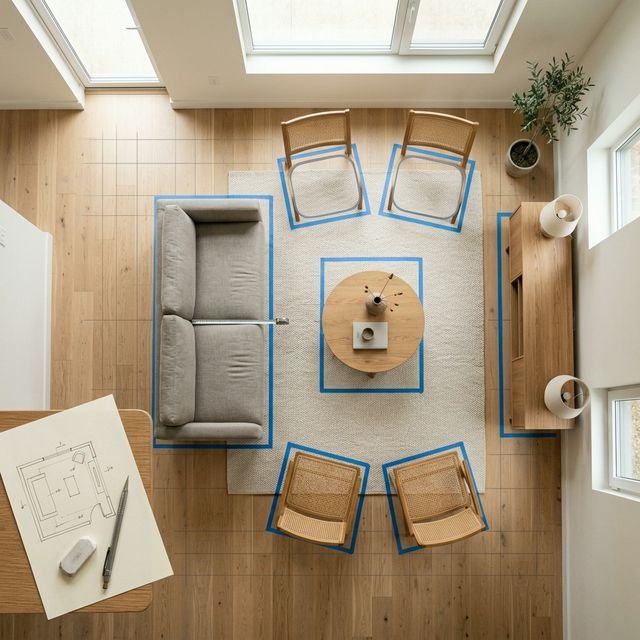
Tape out dimensions before shopping. Before you look at a single listing, tape out the maximum dimensions you could accommodate for a given piece. This gives you a constraint that is grounded in your actual room rather than in aspirations shaped by beautiful photography. The painter's tape comparison explains how to combine that physical check with a visual preview.
Visit showrooms when the piece is available. Even if you ultimately buy online, seeing a sofa range in a showroom calibrates your perception of its scale in a way that carries over to online shopping of related pieces.
Pay attention to your mistakes. Most people who buy furniture regularly have made at least one scale error. Identifying exactly what misled you (the listing photo, the listed dimensions, the colour) makes the next decision more accurate.
Tools that close the gap
Several tools exist specifically to reduce the distance between what you see online and what you will experience in your room.
- Floor planners (Floorplanner, Planner 5D) let you place furniture to scale in a digital version of your space. They are most useful for judging footprint and layout.
- Painter's tape on the floor marks the actual footprint of a candidate piece using its listed dimensions. Simple, free, and a reliable reality check on scale.
- Photo-based AI visualizers composite a product image into a photo of your actual room. They are useful for judging color, style, and visual proportion alongside your existing furniture. See the furniture preview methods guide for the broader workflow.
- Fabric and material samples from the retailer are the only way to accurately evaluate colour and texture before committing to an upholstered or fabric piece.
None of these fully replaces seeing a piece in person. But used in combination, they address the specific blind spots in listing photography (scale, colour, proportion) that cause most furniture regret.