
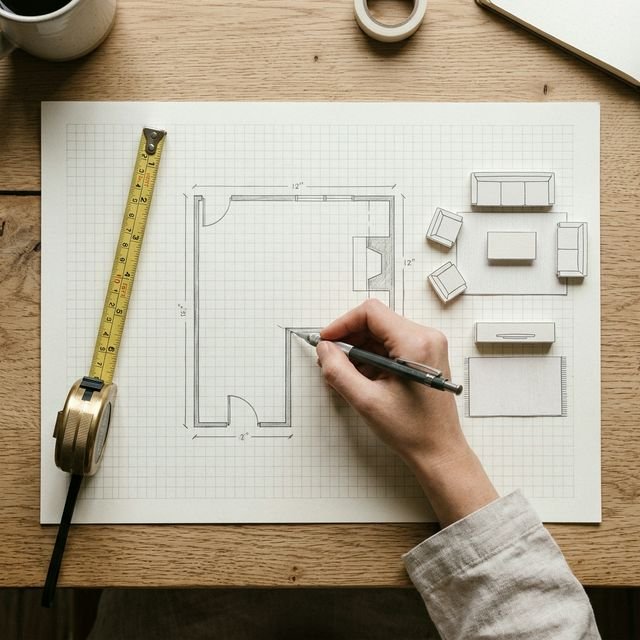
The problem both methods solve
Online furniture shopping requires you to make a physical judgment from a flat screen. You are looking at a sofa, imagining it in your room, and trying to assess whether it will work for size, color, and style. Your brain is not particularly good at this. Neither is anyone else's.
Both painter's tape and AI visualizers exist to reduce the gap between what you imagine and what you will actually get. But they close that gap from opposite ends. Tape makes the physical real. A visualizer makes the visual real. The gap between those two things is where most furniture regret lives.
The painter's tape method
The method is exactly what it sounds like. You take the listed dimensions of the piece you are considering, then use painter's tape to mark out that footprint on your floor. You walk around it, sit adjacent to it (if it is a sofa), try to open nearby doors, and check whether the walkways still work. Start with the measurements in our room-layout planning guide if you have not mapped the space yet.
It is a remarkably useful technique for something that costs nothing beyond the tape. What it confirms:
- Footprint fit. Does the piece physically fit in the space you are planning to put it?
- Clearances. With the piece in position, can you still walk past it comfortably? Do doors clear it? Is there enough space around the dining table for chairs to pull out?
- Traffic flow. Walk the paths you normally take through the room. A piece that technically fits but blocks a natural path will bother you every day.
- Relative scale. Taped dimensions in your actual room are a reality check on what the same piece looks like in a studio photograph. A sofa that seems moderate in a listing photo often tapes out to something much more imposing in a small living room.
What it does not tell you:
- What the piece looks like: color, material, texture, finish
- Whether the style fits with your existing furniture
- How the visual mass of the piece relates to the rest of the room
- Whether the color will read differently under your lighting than in the product photo
In short, tape answers the question: will it fit? It does not answer the question: will it look right?
The AI visualizer method
A photo-based AI visualizer works differently. You upload two things: a photo of your room taken from the angle you use most, and a product photo of the piece you are considering. The tool composites the product into your room photo, estimating perspective and lighting from your image. Our guide to the best ways to preview furniture before ordering compares this with the other available methods.
What a good visualizer tells you:
- Color fit. How the piece's color reads next to your walls, floors, and existing furniture under your lighting conditions, not the studio's.
- Style compatibility. Whether the piece's aesthetic works alongside what you already own.
- Visual proportion. How the piece relates in scale to the rest of the room's visual composition: not just its dimensions, but how much of the room it appears to occupy.
- Comparison between finalists. You can run two or three options through the same room photo and compare them directly, rather than toggling between product tabs and trying to hold the images in memory.
What it does not tell you:
- Whether the piece physically fits. The visualizer does not know your room's dimensions unless you input them
- Exact clearances or traffic paths
- How the piece feels to sit on, or what the material quality is like in person
A visualizer answers: will it look right? It does not replace accurate measurement.
Side-by-side comparison
| Criterion | Painter's tape | AI visualizer |
|---|---|---|
| Cost | Free (tape only) | Free to low-cost (most tools have a free tier) |
| Speed | 5–15 minutes to tape out | Under 1 minute per test |
| Confirms footprint and clearance | ✓ Yes (highly accurate) | ✗ No (not dimensionally reliable) |
| Confirms color and style fit | ✗ No | ✓ Yes (shows in your actual room) |
| Shows visual mass | Partially (footprint only, not height or depth effect) | ✓ Yes (full visual composite) |
| Works with any retailer | ✓ Yes (works from any listed dimension) | ✓ Yes (works from any product photo) |
| Works without a smartphone | ✓ Yes | ✓ Yes (desktop or mobile) |
| Useful for comparing finalists | Possible but slow (re-tape each time) | ✓ Fast (run each option through the same photo) |
| Accounts for your room's light | ✗ No | Partially (estimates from your room photo) |
When to use each
Use painter's tape when:
- You are deciding between differently sized versions of the same piece (a 2-seat vs 3-seat sofa, a 160 cm vs 180 cm dining table)
- You are concerned about clearance: a doorway, a walkway, or how much floor space remains
- The piece is large and the room is small. Tape makes the reality of the footprint undeniable
- You do not have a good room photo for a visualizer, or the photo angle doesn't capture the relevant wall
Use an AI visualizer when:
- You are deciding between two similar-sized options that look different: different colors, materials, or styles
- You are uncertain whether a color is going to clash with your existing furniture or wall color
- You have a shortlist of two or three finalists and want to compare them directly
- The footprint has already passed the tape test and you want to check the visual fit before ordering
Skip both and just measure when:
If clearance is your only question and the dimensions are unambiguous (for example, you need a bookcase that fits a 90 cm alcove and you know the alcove is 92 cm), tape adds little beyond confirming what you already know. A visualizer helps more if you want to see how the bookcase will look in the space.
The combined workflow
The two methods are most valuable used in sequence rather than as alternatives:
- Start with your shortlist. Rather than testing every option, identify two or three realistic candidates first.
- Tape the footprint. Use the listed dimensions to tape out each candidate in position. Confirm the clearances and traffic paths work. Eliminate anything that fails this test.
- Run survivors through a visualizer. Take a clear room photo and test each remaining candidate in it. Compare color, style, and visual proportion.
- Check the return policy. If one option still feels uncertain after both tests, the return conditions are part of the decision too.
- Do a final measurement check. Confirm depth especially. Depth (how far the piece comes into the room) is the dimension most likely to surprise you, and it is easy to mis-read in a product photo.
This sequence takes longer than just ordering and hoping. It is considerably shorter than arranging a return for a piece that does not work.
Which to start with
If you have a clearance concern (a tight space, a narrow walkway, a door that might not clear), start with tape. There is no point aesthetically evaluating a piece that cannot physically work in the room.
If size is clearly not the issue and you are choosing between options that look different, start with the visualizer. It is faster than taping, and you might eliminate candidates on aesthetic grounds before tape is necessary.
For high-stakes purchases (a sofa, a bed, a dining table that you expect to live with for many years), do both. The 20 minutes it takes is a sound investment against the potential cost, logistics, and frustration of a return.
Neither method is a substitute for reading the product specifications carefully, checking independent reviews, and understanding the retailer's return terms. Use the full room-by-room furniture preview checklist before placing a large order. Both methods are tools for a specific part of the decision: the spatial and visual fit.