
What MeltFlex actually is
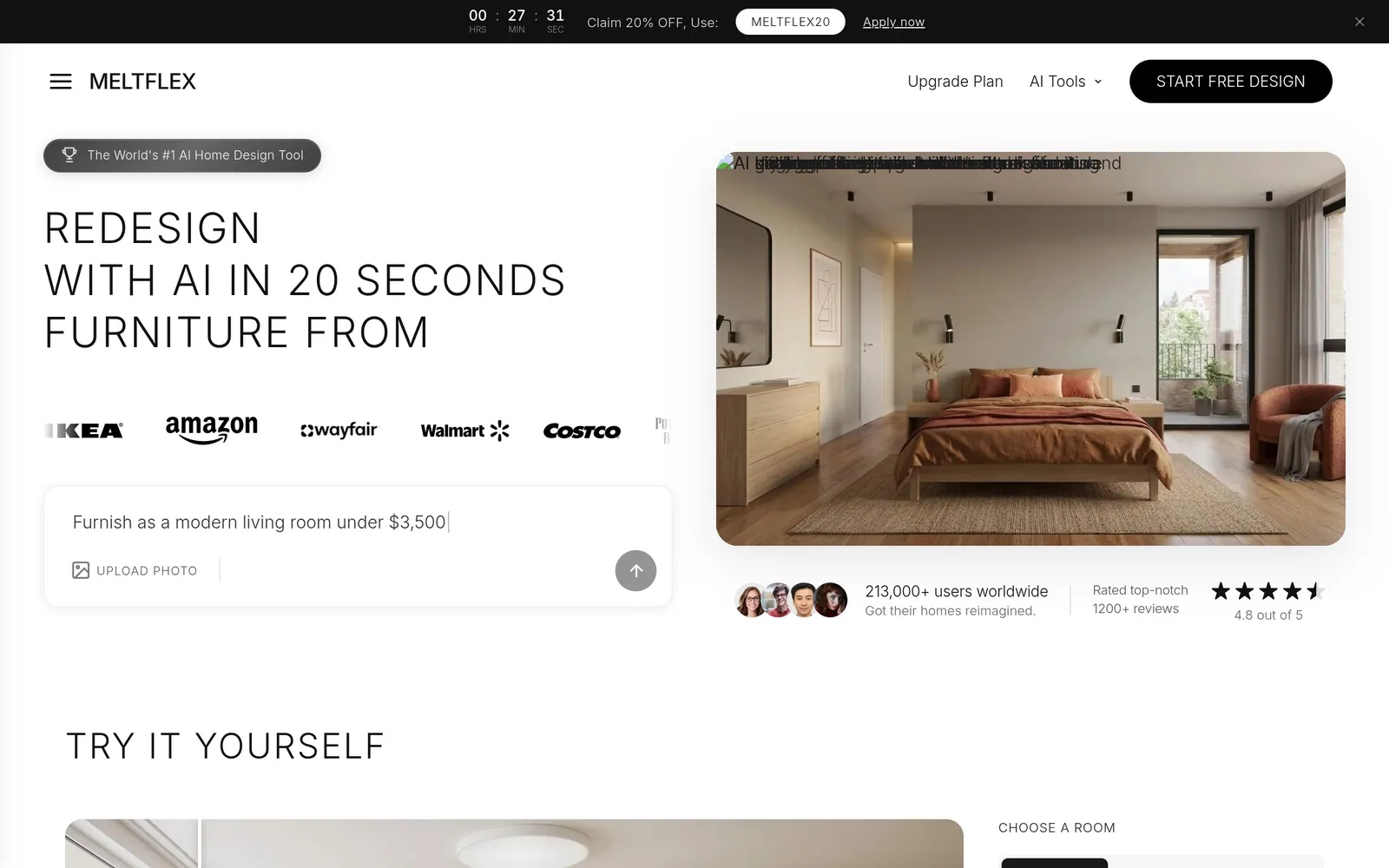
MeltFlex is an AI interior (and exterior) design platform from MeltFlex s.r.o. The headline workflow is: upload a room photo → choose a style → get a photorealistic redesign in roughly 20 seconds → shop pieces shown in the result. Unlike inspiration-only tools that invent furniture, MeltFlex’s public positioning is that items come from real catalogs, IKEA, Amazon, Wayfair, Walmart, Costco, Pottery Barn, West Elm, Ashley, and similar, with live-ish pricing and links to purchase.
Around that core sits a long tool menu: furniture changer, wall textures, floor restyle, kitchen/bath/office/closet specialists, virtual staging, exterior and garden design, floorplan-to-3D, photo-to-render, and video walkthroughs. There is also developer access (API / CLI / MCP) on paid plans. Treat the suite as optional depth; the review question that matters for most readers is still: does the shoppable redesign path help you buy with less regret?
How it works
- Upload a room photo (empty or furnished). Straight, well-lit shots work better than ultra-wide doorway snaps.
- Pick room type, style, and optionally a budget range in the create flow.
- Generate a redesign. MeltFlex markets sub-30-second results for the main path.
- Inspect product cards on placed items, names, brands, prices, and follow shop links to retailer pages.
- Optional tools swap a single sofa, restyle floors/walls, stage empties, or convert floor plans, depending on what you unlock on your plan.
The first generation is free with no credit card required, per MeltFlex’s FAQ. Ongoing use moves to Standard / Pro / Mega-style credit subscriptions (euro pricing on public materials; confirm live rates).
How it performed
Shoppable redesign (the differentiator)
This is where MeltFlex separates from RoomGPT-style mood boards. Seeing a named retail piece with a price and a store link is materially more useful than falling in love with a hallucinated sectional. For shoppers, that closes part of the inspiration-to-purchase gap that pure redesign tools leave open. Read product cards as leads, not contracts: stock, finish variants, shipping, and the final price live on the retailer page.
Speed and breadth
The create experience is built for quick tries across styles (25+ directions in MeltFlex’s materials). Specialist tools (floors, walls, single-item swaps, staging) matter if you are renovating more than furniture, paint, flooring, doors, from the same photo base.
Spatial honesty
MeltFlex claims true-scale placement and dimension-aware catalog items. That is directionally better than inventing furniture with no sizes. It is still not a substitute for measuring doorways, clearances, and delivery paths. Wide-angle phone photos distort rooms; AI will happily furnish a distorted room. Pair any “looks right” render with a tape measure and, for high-ticket pieces, a dedicated fit check. See the scale problem.
Marketing vs editorial judgment
Homepage claims such as “world’s #1,” precise return-rate percentages, and huge user counts are vendor marketing. We do not treat them as independent proof. Evaluate MeltFlex on the workflow you can verify: free first design, shoppable product cards, and whether paid credits match how often you redesign.
When you already have a specific product
Full-room redesign picks a basket for you. If you already shortlisted two sofas from a retailer, a product-in-your-room placement tool (or MeltFlex’s furniture-reference / changer paths, where available) is closer to the decision than another whole-room restyle. Keep the jobs separate.
Pros and cons
What we liked
- Shoppable furniture emphasis, real catalog intent instead of pure hallucination.
- Free first design with no credit card to start.
- Price comparison framing across major retailers.
- Broad tool suite for floors, walls, staging, exteriors, and floor plans if you need more than one furniture pass.
- Developer API for teams embedding redesign/placement.
Where it falls short
- You must still verify product, price, shipping, and returns on the retailer site.
- Geometry remains approximate relative to a measured plan, especially on imperfect photos.
- Paid plans are credit subscriptions; heavy exploration burns budget quickly if you iterate endlessly.
- Aggressive marketing claims need discounting; judge the tool, not the slogan.
- Suite complexity can distract from the simple shopper job of checking one piece.
Pricing
Confirm live numbers on MeltFlex’s pricing page, public figures vary slightly across MeltFlex’s own FAQ and llms.txt materials. The durable structure is:
- Free: first AI room design (no credit card required).
- Paid credit plans: Standard / Pro / Mega (and Enterprise for teams), billed monthly or yearly in euros in current public materials, commonly cited starting around €20–€29/month for entry paid tiers, with higher tiers for more credits and premium tools.
Yearly billing is cheaper per month. After the free generation, unlimited redesign-style usage sits behind a plan. If you only need one weekend of experiments, stay on the free try and stop. If you redesign rooms weekly or stage listings, run the credit math against how many generations you actually keep.
Who it is (and is not) for
MeltFlex is a strong fit if you are:
- A homeowner or renter who wants style ideas tied to products you can actually buy.
- Someone comparing looks across IKEA / Wayfair / Amazon-type catalogs inside one visual.
- A designer or agent who also wants staging, floor-plan, or walkthrough extras in one vendor.
- A developer evaluating an interior-design API with furniture placement endpoints.
It is the wrong tool if you:
- Only need to drop one already-chosen SKU into your room photo.
- Need construction documents, permits, or exact joinery drawings.
- Expect the render alone to guarantee fit without measuring.
Verdict and rating
MeltFlex’s shoppable-furniture positioning is the right problem to solve for online furniture regret. A free first design is enough to learn whether the product cards and styles help your actual rooms. Paid plans make sense for frequent users of the wider suite, not for a single curiosity click.
Editorial rating: 4 / 5 for shoppable redesign workflows, with the caveat that retailer verification and measuring remain mandatory.
Use MeltFlex to shorten the path from “I like this vibe” to “here are real products to compare.” Then finish the decision the old-fashioned way: dimensions, delivery path, return policy, and one last look at the item on the store page.