
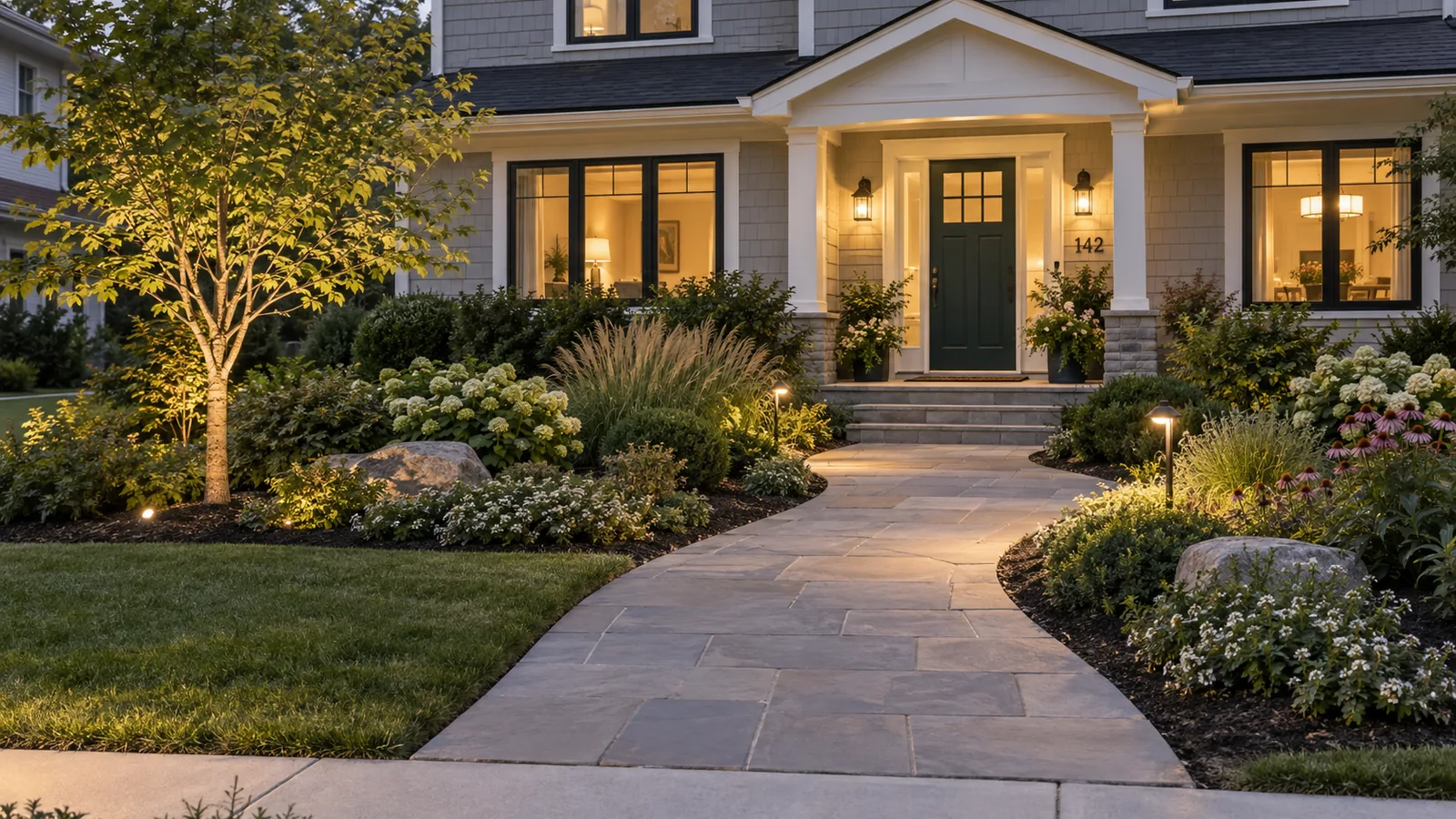
Assess from the street, not from the doorstep
You see your own house from the driveway, at close range, in fragments. Everyone else sees it once, from about 50 ft, for roughly three seconds. Start by reproducing that view.
- Take three photographs. Straight on from the curb, and one from each direction along the street.
- Look at the photos, not the house. A photograph flattens the scene and shows you the composition, which is exactly what a passer-by registers.
- Apply the squint test. Squint at the straight-on shot until detail disappears. What remains is the shape of the house, the mass of the planting, the line of the path, and the dark rectangle of the door. If the door is not one of the things you can still see, that is finding number one.
- Write down the first three things your eye lands on. If they are the bins, a cracked path, and a satellite dish, you now have your priority list, and it has nothing to do with flowers.
Repeat this at night with the lights on. Most front yards are seen in the dark for a significant part of the year, and the night view is usually the one nobody has ever checked.
Structure before planting
Four structural elements determine whether a front yard reads as designed or as accumulated:
Bed lines. The single most transformative and cheapest change. Beds should have a deliberate line: either a clean geometric edge that echoes the house, or a smooth, generous curve. Fussy scallops and tight wiggles look busy from the street. Lay a garden hose on the ground to test the line, walk to the curb, adjust, then cut the edge with a half-moon edger or a spade.
Bed depth. A 2 ft strip of soil against the wall is the default of most builders and it looks like a moat. Aim for 4–5 ft minimum, more for a two-storey facade. Depth is what makes layered planting possible, and layered planting is what makes a front yard look professionally done.
Proportion to the house. Planting mass should relate to the building's height. A single-storey ranch is overwhelmed by 12 ft conifers; a tall Victorian facade is not served by a row of knee-high boxwood. As a starting point, corner anchor plants at maturity should reach roughly one-third to two-thirds of the way up the wall they sit against.
Symmetry, or a deliberate lack of it. Formal facades with a centred door take symmetry well: matching planting on both sides, matching lights, matching containers. Asymmetric houses fight it. Pick one and commit; half-symmetry is the state most front yards drift into and it reads as unresolved.
The three-layer planting model
Nearly every front yard that looks intentional is built in three layers, front to back:
| Layer | Role | Typical mature height | Notes |
|---|---|---|---|
| Anchor / structure | Frames corners, softens vertical edges of the house | 4–10 ft | Mostly evergreen; this is what carries the yard in winter |
| Mid layer | Body and seasonal interest | 18 in – 4 ft | Flowering shrubs, grasses, larger perennials in odd-numbered groups |
| Edge layer | Finishes the bed line, suppresses weeds | Under 18 in | Ground cover, low perennials, bulbs for spring |
Rules that make layers work:
- Odd numbers, grouped. Plant in threes, fives, and sevens rather than singly. One of everything is the most common amateur signature.
- Repeat at least three times. Rhythm comes from repetition. The same grass or the same perennial recurring along the bed ties the whole planting together.
- Space for the mature size, not the pot size. Read the plant tag. A shrub sold at 18 in wide may be 5 ft wide in six years, and overplanting is the reason so many foundation beds end up as an impenetrable hedge against the windows.
- Keep shrubs off the wall. Plant at least half the mature width away from the foundation, typically 3–4 ft. That preserves airflow, keeps siding dry, and leaves access for painting and maintenance.
- Match plant to place. Check sun exposure honestly (full sun means six or more hours of direct sun, part sun three to six, shade under three) and check your hardiness zone or rating before buying. A plant in the wrong exposure will never look good, whatever you do to it.
- Plan for four seasons. Spring bulbs, summer perennials, autumn foliage or berries, and winter structure from evergreens, bark, and seed heads. A yard designed only for peak summer looks bare for two-thirds of the year.
- Consider natives. Regionally native plants generally need less water and less intervention once established, and support local pollinators. Local extension services and botanic gardens publish lists for exactly this purpose.
Trees. A single well-placed small tree does more for a front yard than a dozen shrubs, but placement is a long-term decision. Keep large shade trees 15–20 ft from the house, check for overhead lines, and have underground utilities located before digging. In the US that means calling 811 first, and most countries operate an equivalent free locating service.
The front door: the focal point everything else serves
The door is where the eye should end up. Five inexpensive changes account for most of the effect:
- Colour. A door in a saturated colour against a neutral facade is the highest-impact single change in curb appeal. Test a sample in daylight and at dusk, because colours read very differently under a warm porch light.
- House numbers. Legible from the street, which in practice means 4–6 in tall as a minimum, in a font with real contrast against its background. This is also a genuine safety matter for emergency services.
- Hardware. Handle, knocker, letter plate, hinges, and bell. Mismatched finishes are visible from surprisingly far away; matching them is a one-afternoon job.
- Lighting. Two matched lights flanking the door, or one centred overhead. Scale is the usual error: exterior fixtures generally need to be larger than they look in the shop.
- The threshold. A clean mat, swept step, and clear porch. Nothing stored on the porch that is not intended as decoration.
Containers either side of the door are the standard finishing move, and the standard mistake is buying them too small. Large pots read as architecture; small ones read as clutter, dry out faster, and need daily watering in summer.
Paths, driveways, and edges
Width. A front walk should be 48 in wide where possible, allowing two people to walk side by side. 36 in is the workable minimum; anything narrower makes visitors walk single file to your front door, which is a poor welcome and looks mean from the street. Widening a path is disruptive but it changes the whole approach.
Route. The path should go where people actually walk. If there is a worn track across the lawn from the driveway to the door, that is the desire line, and the honest solution is a path along it rather than a sign asking people not to.
Materials. Match or complement the house rather than the neighbours. Whatever the material, level and safe beats attractive and uneven. Lifted slabs and rocking pavers are both a hazard and the first thing a visitor notices.
Edges. A crisp edge between lawn and bed, and between lawn and paving, is what separates a maintained yard from a neglected one at a glance. Steel, aluminium, brick, or a simple cut trench all work. The trench costs nothing and needs redoing twice a year.
Driveway. It is usually the largest surface in the front yard and gets the least attention. Weeding the joints, cleaning stains, and defining the edge with a planted strip or a mowing band changes the balance of the whole composition.
Lighting the approach
Exterior lighting is where enthusiasm most often overshoots. The goal is a legible, welcoming approach, not a lit runway.
- Warm and low. Around 2700 K and modest output: path lights in the region of 50–100 lumens each are ample. Cool white floodlighting flattens a facade and irritates the street.
- Stagger path lights. Alternate sides rather than facing them in pairs, and space them so pools of light just meet. Evenly matched rows either side create the airport-runway effect.
- Shield downward. Fixtures that throw light down light the ground you are walking on, avoid glare, and reduce light trespass into neighbouring windows.
- Uplight sparingly. One or two uplights on a specimen tree or an interesting architectural feature is a strong effect. Five is a car park.
- Light the number and the door. If visitors and deliveries cannot find the house at night, the lighting has failed regardless of how it looks.
- Motion sensors for security, low light for looks. They are different jobs and generally want different fixtures.
Lawn and its alternatives
A small, healthy, well-edged lawn looks far better than a large struggling one. Two directions are worth considering:
Keep it, shrink it. Reduce the lawn to a simple, mowable shape with clean edges, and give the reclaimed area to deeper beds. Simple shapes also cut maintenance time, because every awkward corner is a place a mower cannot reach.
Replace some of it. Ground cover, gravel gardens, planted meadow strips, and permeable paving all reduce watering and mowing. In dry regions this is often the single biggest change available. Two cautions: bare gravel with a few scattered plants tends to look austere rather than designed, so plant it densely; and check local ordinances or homeowner association rules before removing a front lawn, since some still mandate turf.
Either way, the visible standard is edges and evenness, not species. A modest lawn with sharp edges outperforms a large one with ragged ones.
Screening bins, meters, and units
Bins, air-conditioning condensers, utility meters, and hose reels are the items that quietly undo everything else. They can be screened, but not blindly:
- Keep service clearances. Condensers need free airflow, commonly 24–36 in of clearance on the sides, and manufacturers specify their own figures. Meters must stay accessible for reading and emergency shut-off. Screening that blocks either causes real problems.
- Screen with a slatted panel or an open shrub group rather than a solid enclosure, so air still moves.
- Give bins a dedicated store. A simple timber store on the side of the house, on a hard standing, with a route to the street that does not cross the lawn.
- Address the cabling. Clipping loose runs of cable neatly along a line and painting exposed conduit to match the wall costs almost nothing and removes visual noise.
Maintenance that actually shows from the street
- Mulch, correctly. 2–3 in deep across the beds, pulled back 2–3 in from trunks and stems. Mounding mulch against a trunk, the "mulch volcano," traps moisture against the bark and damages the tree. Mulch also suppresses weeds and evens out the appearance of a bed better than anything else per pound spent.
- Edge twice a year. Spring and mid-season. The single highest ratio of visual improvement to effort in the whole yard.
- Prune at the right time. Shrubs that flower on old wood are pruned after flowering; cutting them back in late winter removes the year's display. Check the individual species rather than pruning everything on the same day.
- Check the grading. Ground should fall away from the foundation. A common residential guideline is about 6 in of drop over the first 10 ft. Beds that have been topped up year after year sometimes end up sloping back toward the house.
- Clean the gutters and wash the facade. Streaked gutters and a green-tinged north wall are read as neglect even by people who could not say what they are looking at.
- Wash the windows. Rarely mentioned in landscaping advice, immediately visible in a photograph from the curb.
A phased plan by budget
Front yards are best improved in a fixed order, because each stage makes the next one easier.
A weekend, minimal spend. Edge every bed and hard surface. Weed and mulch. Trim anything blocking a window or the path. Clean the door, polish or replace the hardware, put up legible house numbers, and replace the mat. Wash the windows. This alone resolves most of what a squint test flags.
One season, moderate spend. Redraw and deepen the bed lines. Paint the front door and, if needed, the trim. Add two large containers. Plant the mid and edge layers with repeated groups. Add basic path lighting. Build or buy a bin store.
Multi-year, larger spend. Plant the anchor layer and any trees, because these need years to mature, so plant them first even though they show last. Rebuild or widen the walkway. Regrade if drainage is a problem. Replace the driveway surface. Add permanent low-voltage lighting on a timer.
The general principle is the same one that governs interiors: settle the structure before you spend on the finishes. Our guide to planning a layout before buying anything makes the indoor version of the same argument.
Common mistakes
- Beds too shallow. A narrow strip against the wall cannot be layered and always looks like an afterthought.
- Planting for the pot size. Overcrowded foundation beds that swallow the windows in five years are the predictable result.
- One of everything. Variety without repetition reads as a collection, not a design.
- Annual flowers as the whole strategy. Colour without structure disappears in October and takes the yard with it.
- Over-lighting. Bright, cool floodlights flatten the facade and annoy the street; a few warm, shielded fixtures do more.
- Ignoring the night view. Half the year, that is the view.
- Decorating before repairing. A lifted paving slab, a broken gate, or a sagging gutter outweighs any amount of planting.
Work from the street inward: fix what the eye lands on first, get the structure right, then plant in layers that carry all four seasons. The flowers are the easy part.