
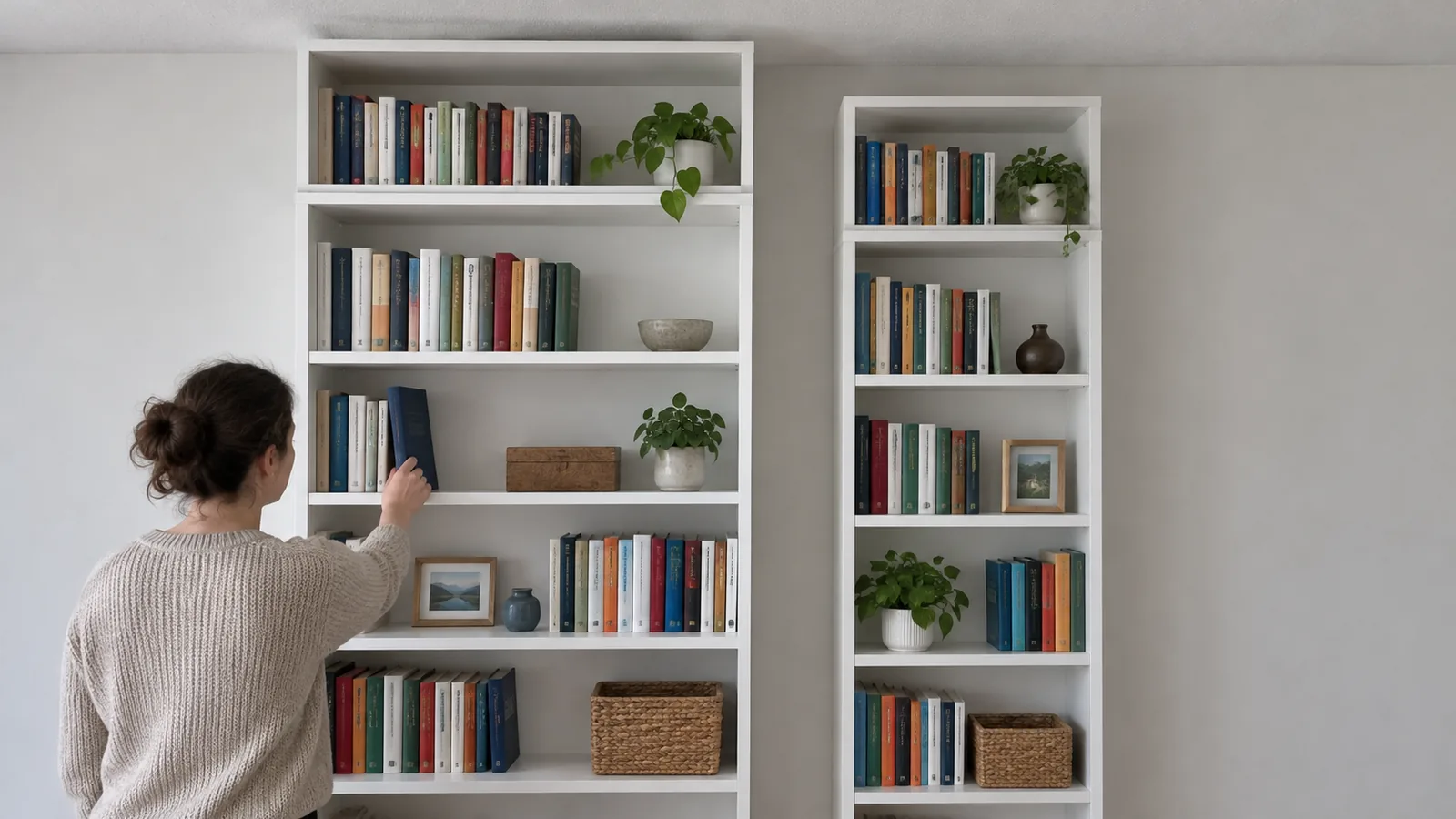
The short verdict
BILLY is still the easiest cheap way to put a wall of shelves into a room, as long as you plan around its fixed sizes and its wide shelves. The narrow cases are the safer choice for heavy books; the wide ones are better value per foot of wall but bow sooner. Every size must be fixed to the wall, and the extension unit leaves very little room under a standard 8 ft ceiling.
Choose BILLY if
- You want shelves on a budget that you can add to later
- Your books are mostly paperbacks and mixed objects, not rows of heavy hardbacks
- You can fix the cases to the wall
- You want the option of doors or a built-in look with extension units
Look elsewhere if
- You need deep shelves: every current US BILLY is 11 in deep
- You store records, art books, or files that load a wide shelf heavily
- You cannot drill into the wall
- You want to paint it: IKEA says the foil finish is not designed for paint
How we reviewed it
This is a source-verified review. In October 2026 we read IKEA US product pages for the four white BILLY cases, including the 31 1/2 x 79 1/2 in case and the 15 3/4 x 79 1/2 in case, the two height extension units, the corner hardware, the extra shelf, and the OXBERG, HÖGBO, and HÖGADAL doors, plus IKEA's BILLY assembly instructions and extension unit instructions. The sag section uses published engineering guidance, and its estimates are ours, not IKEA's. We have not built or loaded a BILLY.
Every BILLY size, in inches and cm
| BILLY (IKEA US, October 2026) | Shelves included | Max load per shelf | White | Wood effects |
|---|---|---|---|---|
| 15 3/4 x 11 x 41 3/4 in (40 x 28 x 106 cm), 105.220.37 | 2 adjustable | 31 lb (14 kg) | $39 | $49 |
| 31 1/2 x 11 x 41 3/4 in (80 x 28 x 106 cm), 905.220.43 | 2 adjustable | 66 lb (30 kg) | $49 | $59 |
| 15 3/4 x 11 x 79 1/2 in (40 x 28 x 202 cm), 505.220.40 | 1 fixed, 4 adjustable | 31 lb (14 kg) | $59 | $69 |
| 31 1/2 x 11 x 79 1/2 in (80 x 28 x 202 cm), 205.220.46 | 1 fixed, 4 adjustable | 66 lb (30 kg) | $79 | $89 |
| Height extension, 15 3/4 x 11 x 13 3/4 in (40 x 28 x 35 cm), 405.252.75 | none listed | $25 | $30 | |
| Height extension, 31 1/2 x 11 x 13 3/4 in (80 x 28 x 35 cm), 805.252.78 | none listed | $30 | $35 |
Wood effects are oak, dark-brown oak, black oak, and brown walnut, and IKEA sells some sizes in colours. Bundles with an extension cost $84 (narrow) and $109 (wide) in white. IKEA US lists no deeper BILLY: every current case is 11 in deep, or 11 3/4 in with doors. Customer ratings were 4.5 of 5 from 2,099 reviews for the wide tall case and 4.7 from 1,638 for the narrow one.
- AWith the extension, 93 1/4 in leaves 2 3/4 in (7 cm) below a 96 in ceiling, before any crown moulding.
- BDashed line: 80 3/4 in (205 cm), the minimum ceiling height IKEA lists for standing the 79 1/2 in case up.
Height extensions and ceiling clearance
The extension unit is a 13 3/4 in (35 cm) box that sits on a tall case of the same width and takes the total to 93 1/4 in (237 cm). IKEA's instructions have you stand the tall case up first, then lift the assembled extension on top and join it with dowels and fittings, and the extension gets its own wall fixing: the product page says a safety strap is included. Every BILLY page also carries the same note: "you need enough space between the top of the furniture and the ceiling to be able to anchor the product to the wall."
| Your ceiling | Tall case (79 1/2 in) | With extension (93 1/4 in) |
|---|---|---|
| 80 in (6 ft 8 in), some basements | Below IKEA's 80 3/4 in minimum for standing it up | Does not fit |
| 8 ft (96 in) | 16 1/2 in above | 2 3/4 in above: check crown moulding and smoke alarms |
| 9 ft (108 in) | 28 1/2 in above | 14 3/4 in above |
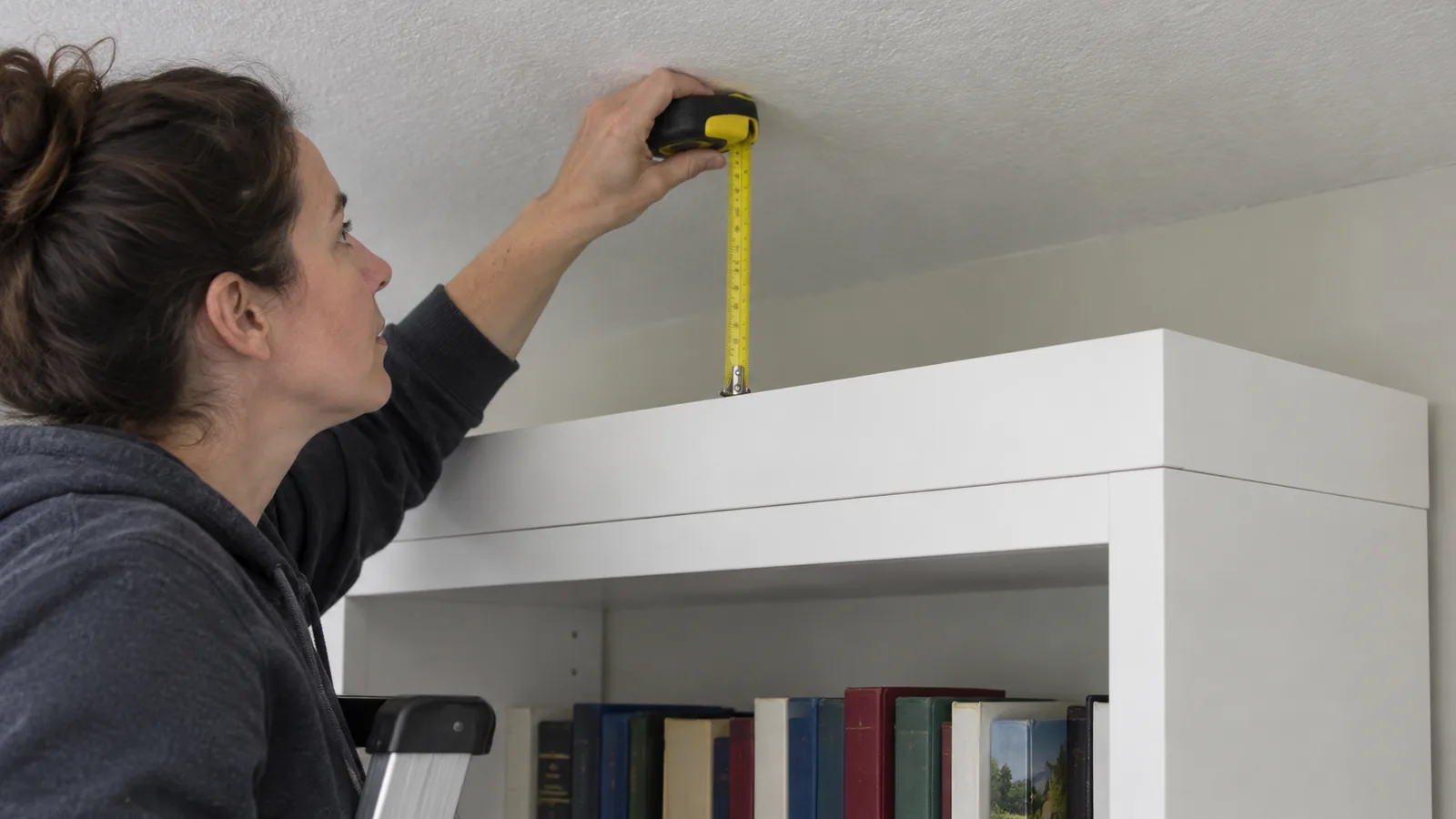
The 80 3/4 in figure exists because a case tipped up from the floor sweeps an arc slightly taller than itself; for a 79 1/2 x 11 in side profile the diagonal is about 80 1/4 in. On an 8 ft ceiling that is no problem. The tight spot is the extension: 2 3/4 in is enough room to lower a box over dowels and reach a bracket screw, but not if crown moulding hangs lower than that. Measure the moulding's drop and the ceiling height at the wall, not in the middle of the room. One owner review of the extension on IKEA US describes adding crown moulding to finish the look, which only works if you leave room for it.
Which doors fit BILLY
BILLY doors are 15 1/2 in (39 cm) wide, so one fits a narrow case and two fit a wide one. They come in three heights to match the low case, the tall case, and the extension. They add 3/4 in, making the cabinet 11 3/4 in deep. IKEA's door pages say they do not fit bookcases bought in spring 2014 or earlier, which matters if you are adding doors to a secondhand case. The same note appears on the extra shelves.
| Door (white unless noted) | Size | Fits | Price |
|---|---|---|---|
| OXBERG panel door | 15 1/2 x 75 3/4 in | Tall case | $45 |
| OXBERG glass door | 15 1/2 x 75 3/4 in | Tall case | $50 |
| OXBERG panel door, glass door | 15 1/2 x 38 1/4 in | Low case | $30, $35 |
| OXBERG glass door | 15 1/2 x 13 3/4 in | Extension unit | $25 |
| HÖGBO glass door | 15 1/2 x 75 3/4 or 38 1/4 in | Tall or low case | $65, $50 |
| HÖGADAL woven bamboo door | 15 1/2 x 75 3/4 or 38 1/4 in | Tall or low case | $80, $55 |
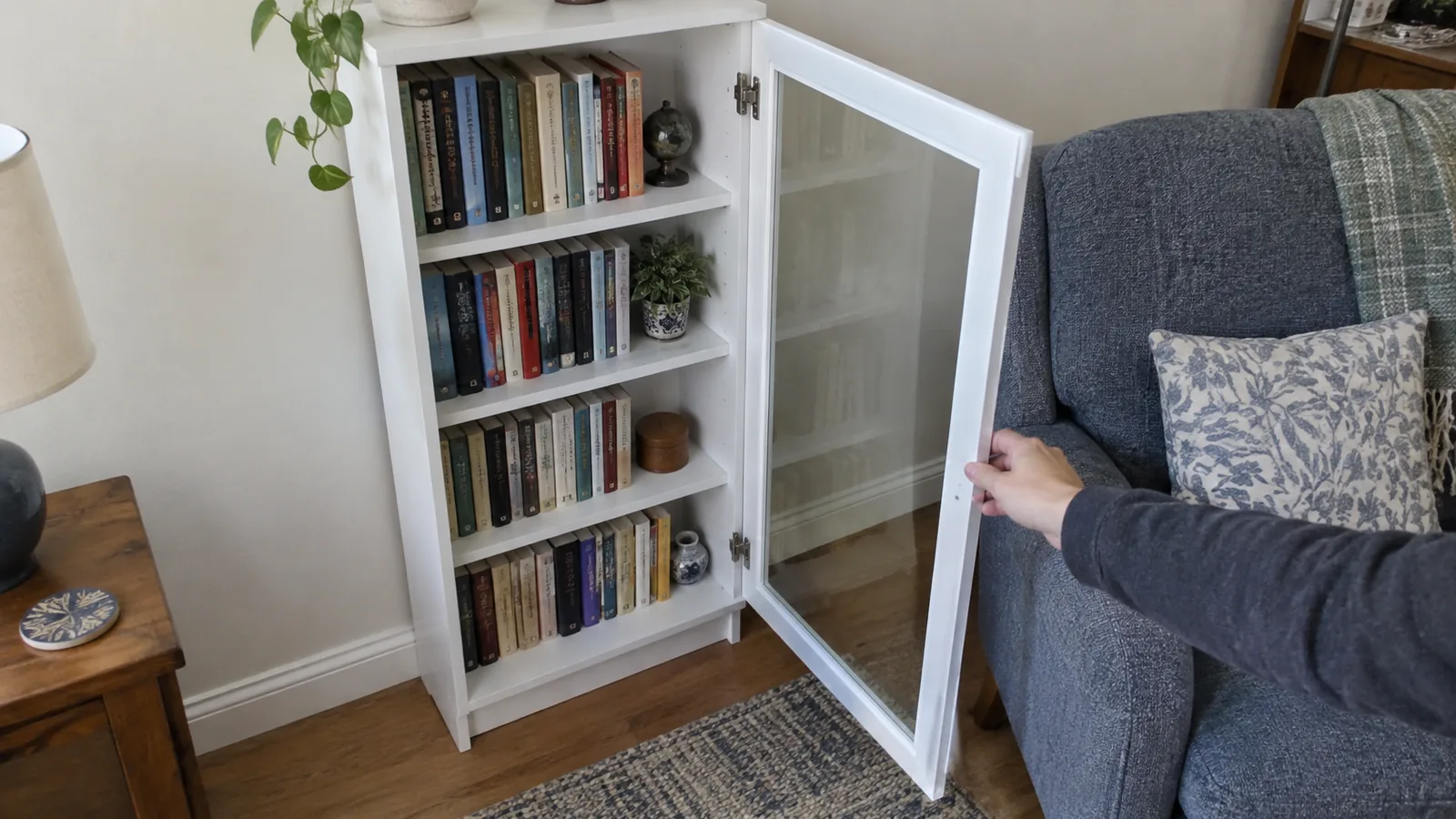
Two practical limits: OXBERG's page says its doors can go on a corner unit only if the case next to it has no doors, and hinged doors swing about 15 1/2 in into the room, so a door case in a narrow hallway needs that clearance.
Shelf load limits and sag
IKEA lists a maximum load of 66 lb (30 kg) per shelf on the 31 1/2 in cases and 31 lb (14 kg) on the 15 3/4 in cases. The wide case's shelf is 29 7/8 x 10 1/4 in and 3/4 in thick; the narrow shelf is about 14 in long. Per inch of shelf the two limits are nearly the same, about 2.2 lb per inch, but the wide shelf will still bow far more.
The reason is span. Woodbin's Sagulator, a shelf-sag calculator built on standard beam formulas, puts it simply: "If shelf span is doubled, deflection is eight times greater." The wide BILLY shelf spans a little over twice the narrow one, so under the same total weight it sags roughly nine to ten times as much, and with the same books per inch, roughly twenty times. That is our estimate from the beam relationship, assuming the same board and thickness, not an IKEA figure. Woodbin adds that wood shelves can sag a further 50% over time under a constant load.
- A15 3/4 in case: 14 in shelf, IKEA limit 31 lb (14 kg).
- B31 1/2 in case: 29 7/8 in shelf, IKEA limit 66 lb (30 kg). Roughly twenty times the sag of A at the same load per inch, by our estimate.
- CSame shelf with heavy books by the side panels and light items in the middle: weight near the supports bends the shelf less.
A full shelf can also exceed IKEA's limit without looking overloaded. The Composite Panel Association's shelving bulletin notes that "bookshelf loads can easily reach 50 psf". On the wide BILLY shelf's area that would be about 106 lb, and about 49 lb on the narrow shelf, against limits of 66 and 31 lb. Ways to reduce sag:
- Put heavy books on the narrow cases or on the bottom shelf, which rests close to the base, and keep the wide shelves for lighter things.
- Load the ends, not the middle, as in C above.
- Flip a bowed shelf so the curve points up. This is a common owner fix, not an IKEA instruction, and the wood will creep again under the same load.
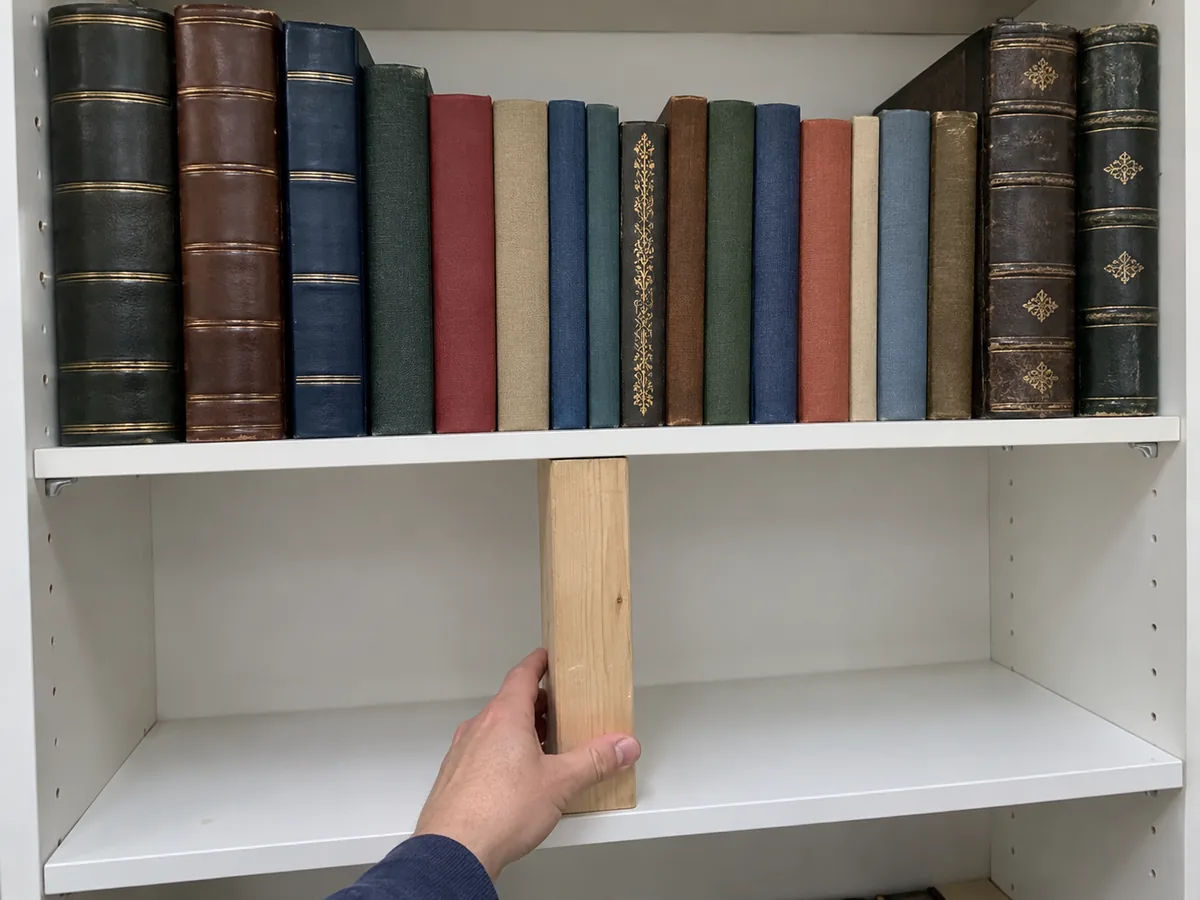
- Add support: the CPA bulletin says a centre support lets a shelf span further, and a strip under the front edge reduces front-edge sag. A wood block standing on the shelf below works as a mid support.
Anchoring and materials
IKEA's instructions warn that "serious or fatal crushing injuries can occur from furniture tip over" and that BILLY must be used with the wall fixings provided. The brackets and the screws that attach them to the case come in the box; the screws and plugs for the wall do not, because they depend on your wall. Use a stud where the bracket lands on one, and ask a hardware store about plaster, masonry, or metal studs. Each extension unit has its own strap. BILLY is not covered by the US tip-over standard for dressers, which excludes bookcases, so anchoring is the only safeguard. Our MALM review has a wall-by-wall fixing table.
| Part | Material (IKEA US) | What it means |
|---|---|---|
| Shelves, top, base | Particleboard, paper foil | Light and cheap; chipped edges are hard to repair |
| Side panels | Particleboard, paper foil, plastic edging | Wipe clean only; IKEA says it is not designed to be painted |
| Back | Fiberboard, paint, paper foil | Thin. IKEA's own FAQ says it is often compared to cardboard |
Two themes recur in IKEA US owner reviews: back panels arriving damaged or splitting at a seam, and new cases not matching the shade of ones bought a year or two earlier, which one reviewer says IKEA put down to supplier changes. If you plan to add cases later, buy them in one batch. Our solid wood vs engineered wood comparison explains what particleboard and foil mean for repairs.
Planning a full BILLY wall
A BILLY wall is just widths adding up. Plan from the fixed sizes, not from the wall, and leave a little tolerance: one owner notes that two cases side by side were flush at the base but not at the top, which happens when floors or walls are not true.
| Wall width | Cases | Total | Left over |
|---|---|---|---|
| 84 in (7 ft) | 2 wide + 1 narrow | 78 3/4 in | 5 1/4 in |
| 96 in (8 ft) | 3 wide | 94 1/2 in | 1 1/2 in, tight on a crooked wall |
| 120 in (10 ft) | 3 wide + 1 narrow | 110 1/4 in | 9 3/4 in |
| 144 in (12 ft) | 4 wide + 1 narrow | 141 3/4 in | 2 1/4 in |
- Corners: BILLY corner hardware ($13, two-pack) fits the 15 3/4 in case only. IKEA's ready-made corner combination of three narrow cases measures 37 3/8 in along each wall.
- Baseboards: IKEA's assembly drawing shows a notch at the bottom back of each side panel that sits over a baseboard. Compare your baseboard with the notch before assuming the case will sit flat against the wall.
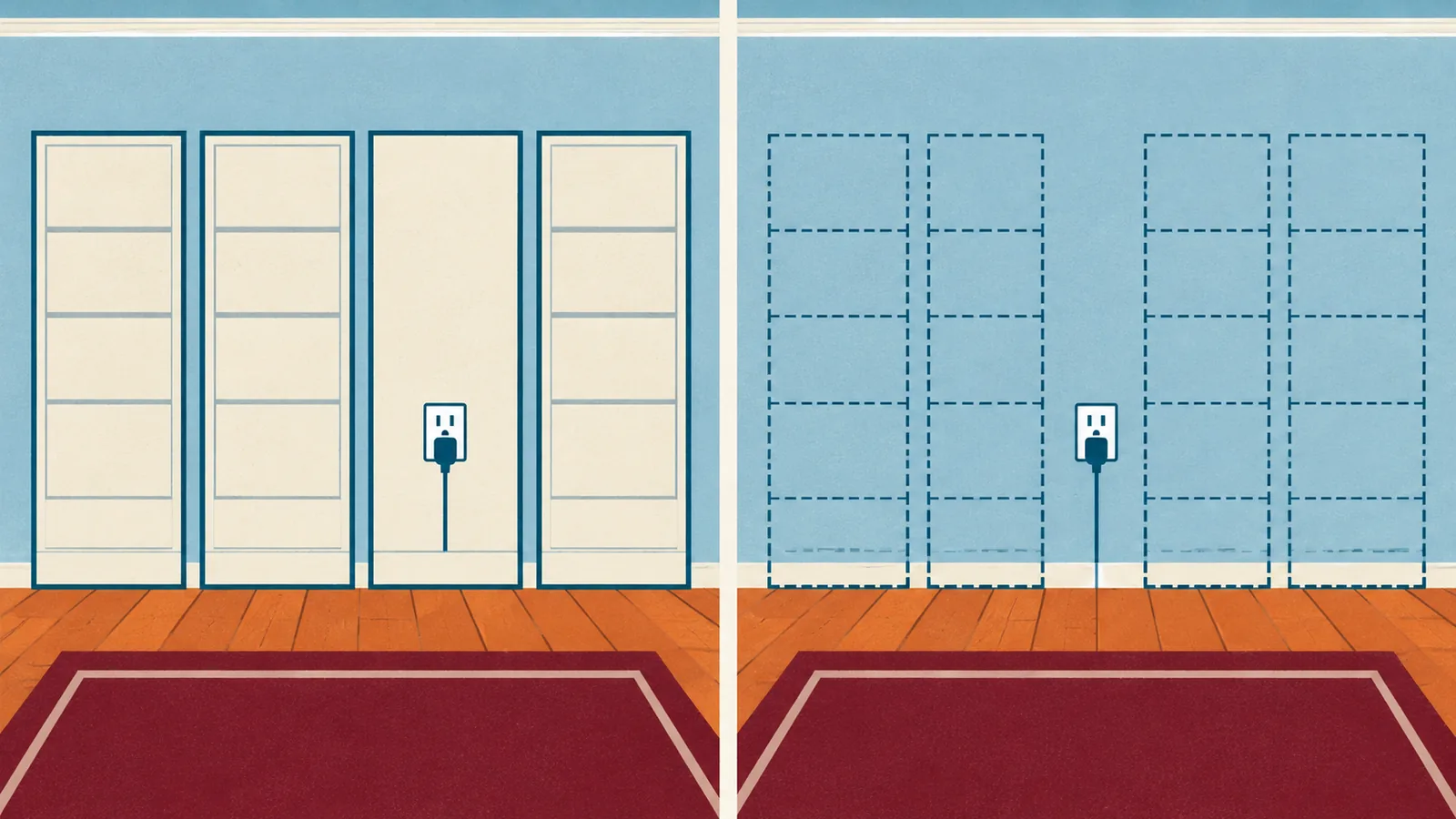
- Outlets and switches: the back panel covers anything behind it. Tape the case outlines on the wall and shift the layout so sockets land in a gap, at an end, or above a low case.
- The room: an 11 in deep wall of shelves takes little floor, but keep the walkway in front clear. See our living room layouts for a reading zone built around a bookcase.
Who it suits, and who should skip it
- Mostly paperbacks and mixed objects?Wide cases are the best value per foot of wall.
- Heavy hardbacks, records, or files?Use narrow cases, or plan mid supports for the wide shelves.
- An 8 ft ceiling with crown moulding?Measure the drop; the extension leaves only 2 3/4 in.
- Cannot drill into the wall?Do not use tall cases; choose low furniture instead.
Measure the wall at the floor, middle, and top, the ceiling at the wall, and the baseboard height, then add up the cases before you order. Buy every case you need at once so the finishes match.