
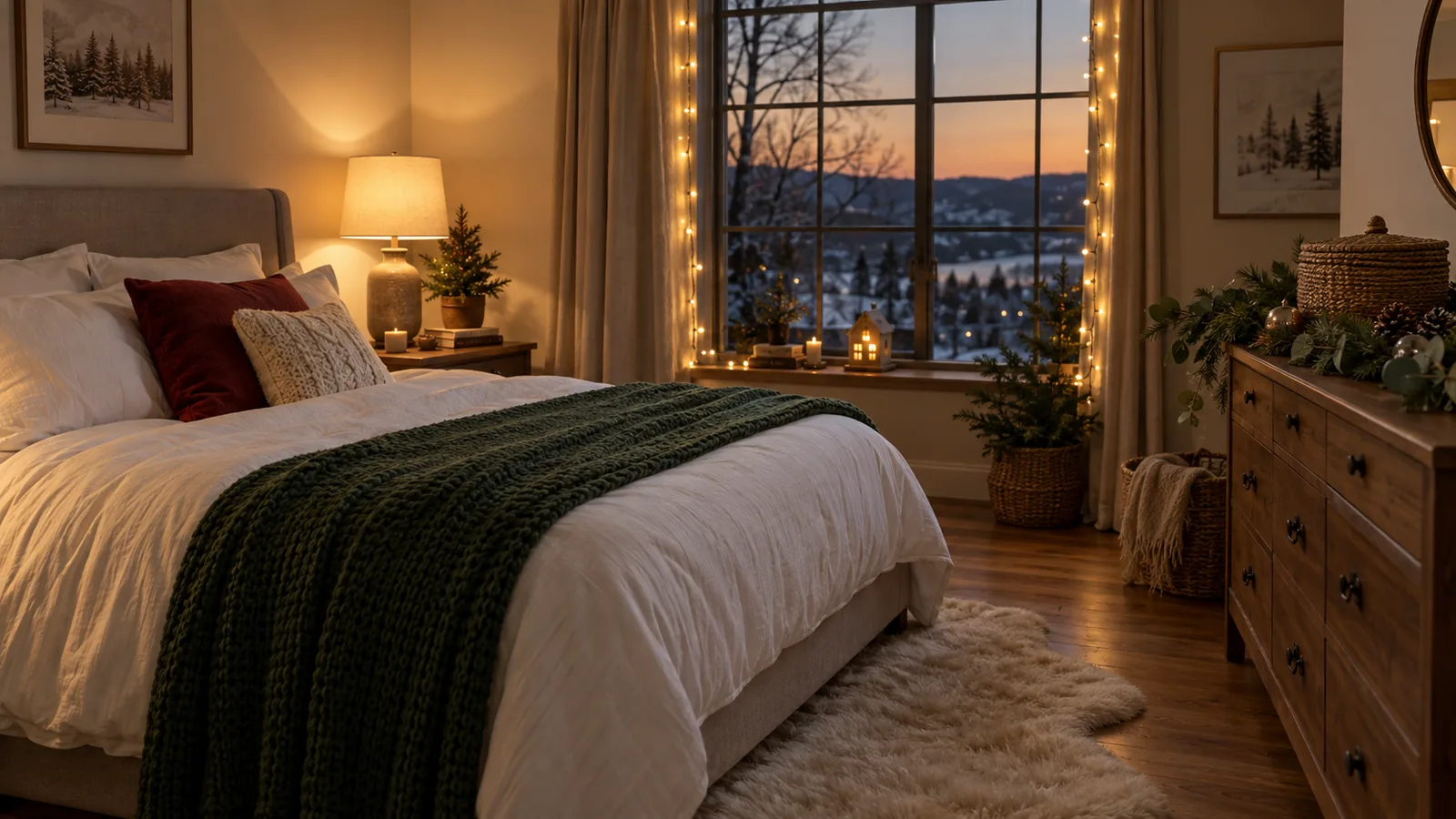
Why bedrooms are different from the rest of the house
Most Christmas decorating advice is written for living rooms and entryways, spaces designed to be looked at. A bedroom is designed to be slept in, and four constraints follow from that:
- Light discipline. Bright, blue-rich light in the evening works against the body's wind-down. Anything you add has to be warm and easy to switch off.
- Air quality. A bedroom is enclosed for eight hours at a stretch. Strong scent, dust-catching garlands, and real greenery all have more effect here than in an open-plan living space.
- Surface scarcity. Nightstands hold a lamp, a glass of water, a phone, a book. There is far less spare surface than in a living room, so decoration competes with function.
- Proximity. Anything hung above a bed is directly over someone's head for the night. That raises the bar for how it is fixed.
The practical consequence: bedrooms reward layering over adding. Change what is already there (bedding, lighting, one surface) rather than introducing a lot of new objects.
Choosing a palette that works with what you own
The most common bedroom mistake is importing a living-room scheme wholesale. Saturated red and green against a soft grey or blush bedroom reads as clash rather than festivity. Start from the colours already in the room (wall colour, flooring, headboard, curtains) and pick a scheme that extends them.
| Palette | Works best in | How to apply it |
|---|---|---|
| Scandinavian: white, pale wood, green | Light, neutral, or minimalist bedrooms | White bedding, a single eucalyptus or fir garland, natural wood and paper ornaments |
| Warm neutral: cream, oatmeal, brass | Beige, taupe, and greige rooms; small bedrooms | Textured throws, brass or amber glass, dried grasses and orange slices |
| Jewel tones: emerald, plum, deep teal | Dark or north-facing bedrooms with rich walls | Velvet cushions, a deep-toned throw, gold accents; skip red entirely |
| Traditional red and green | Rooms with wood furniture, plaid, or classic bedding | Use as accents only: a plaid throw and two cushions, not full bedding |
| Monochrome plus one metal | Modern bedrooms where colour would fight the scheme | Keep every existing colour; add only white lights, silver or brass, and greenery |
One rule covers all five: pick three colours and stop. Bedrooms are small enough that a fourth reads as clutter.
Textile layering: the highest-return change
If you do only one thing, do this. Textiles are the bedroom's largest visible surface, they cost nothing to swap back, and they change the room's temperature in both senses.
- Change the duvet cover to a winter weave. Brushed cotton, flannel, or linen in a heavier weight reads as seasonal without a single ornament. Keep it in a colour you can live with through February.
- Add a throw across the foot of the bed. Folded in thirds and laid across the bottom third of the mattress is the standard styling; draped diagonally is softer. Wool, mohair, and chunky knits carry the season best.
- Swap two cushion covers, not six. A bed piled with cushions has to be unpiled every night. Two seasonal covers on the cushions you already use is the sustainable version.
- Consider a layered rug. A sheepskin or flatweave over an existing rug on the side you get out of bed is a genuine comfort upgrade in winter, not just a look.
- Keep the sleeping layer neutral. Sheets and pillowcases stay as they are. Colour goes in the layers you can strip off in a minute.
That last point is what makes a bedroom scheme survive: on 2 January you remove the throw and two covers and the room is back to normal.
Lighting without wrecking your sleep
Lighting is where bedroom decorating most often backfires. Three specifics matter:
Colour temperature. Aim for 2200–2700 K, the warm, amber end. Packaging usually labels this "warm white" or "extra warm white." Cool white and daylight bulbs (4000 K and up) are the ones that make a bedroom feel like a retail display and are the least helpful in the hour before sleep.
Steady, not flashing. Twinkle and chase modes draw the eye constantly, which is fine on a tree in a living room and genuinely disruptive within a few feet of a pillow. If a set has modes, set it to steady.
Automatic off. Put string lights on a plug-in timer, a smart plug, or a set with a built-in timer function. This solves both the sleep problem and most of the safety problem at once, because nothing runs unattended overnight.
Placement ideas that suit bedrooms:
- Behind sheer curtains. The fabric diffuses the points of light into a soft glow, the single best-looking string-light placement in a bedroom.
- Along a headboard or bed frame. Battery-powered fine-wire lights avoid a cord running across the floor.
- Inside a glass vessel. A jar or vase of lights on a dresser gives a lamp-like pool of light instead of a line.
- Around a mirror or window frame. Uses the architecture instead of adding an object.
- A dimmer or smart bulb in the existing lamp. The lowest-effort improvement: the fixture is already there and already positioned correctly.
The bed as focal point
The bed occupies most of the visual field, so it is the natural place to concentrate effort, with a caveat about anything overhead.
- Headboard garland. A fir, eucalyptus, or faux garland run along the top of a headboard, ideally secured to the headboard itself rather than the wall.
- A wreath above the bed. Effective, but fix it to a stud or use a rated wall anchor. Lightweight faux or dried wreaths are the sensible choice above a pillow; heavy fresh wreaths are not.
- Canopy or four-poster swags. The one bed style that carries generous decoration well, because the structure is doing the work.
- Nightstand tray. A small tray with a candle-style LED, a sprig of greenery, and one ornament contains the decoration and keeps the surface usable.
- Bench or blanket box at the foot. Somewhere for the folded throw and a couple of cushions when you go to bed.
How much a headboard can carry depends on its scale and how it sits against the wall, worth thinking about before you buy one, which our guide on checking whether a bed frame works in your bedroom covers in detail.
Greenery, small trees, and scent
Real versus faux. Real fir and eucalyptus smell better and look better for about two weeks. In a bedroom they also drop needles into carpet, need misting to last, and can carry mould spores that bother allergy sufferers. Faux garlands and preserved eucalyptus avoid all three and store flat. Dried elements (orange slices, pinecones, cinnamon sticks, bay leaves) sit in between: natural, no maintenance, no watering.
A tree in the bedroom. A tabletop tree of 2–3 ft on a dresser is usually the right scale; a full-size tree eats floor space you need for getting dressed. Keep it away from radiators and clear of the door swing.
Pets and small children. Holly and mistletoe berries are toxic if eaten, and mistletoe is the more serious of the two. Poinsettia is commonly overstated as a danger but is still an irritant. Keep all three out of reach or leave them out of a bedroom shared with a cat, dog, or toddler.
Scent, carefully. An enclosed bedroom concentrates fragrance. Heavy diffusers and plug-ins that are pleasant in a hallway can cause headaches or trigger asthma overnight. If you want seasonal scent in a bedroom, use it briefly in the evening and ventilate before sleeping, or rely on the faint natural scent of real greenery and dried spices instead.
Small bedrooms and rentals
In a room under about 10 × 10 ft, floor space is the scarce resource and every added object is felt.
- Go vertical. Window frames, door frames, the wall above the headboard, and the back of the door all decorate without consuming floor area.
- One statement, two accents. A lit window plus a throw and a nightstand tray is a complete scheme in a small room. A third feature usually tips it into clutter.
- Use mirrors. String lights reflected in an existing mirror double the effect at no spatial cost.
- Skip the tree, keep the branch. A few tall branches in a floor vase with a handful of ornaments gives the vertical gesture without the footprint.
- Renter-safe fixings. Removable adhesive hooks, tension rods inside window reveals, and over-door hangers avoid holes. Check the weight rating on adhesive hooks and never use them above a bed.
Kids' rooms and guest rooms
Kids' rooms take more decoration and need more caution. Favour fabric, felt, and wood ornaments over glass; keep small parts away from under-threes; use battery-powered lights so there is no cord within reach of a cot or toddler bed; and secure anything on a wall properly. An advent element (a calendar, a countdown chain, a nightly ornament) gives the room a daily ritual and spreads the decorating over a month.
Guest rooms need the opposite instinct. A guest needs empty surface for their belongings, somewhere to put a suitcase, and space in the wardrobe. Decorate lightly: fresh bedding with one seasonal layer, a small lamp or lit jar, a spare blanket at the foot of the bed, and a clear nightstand with room for a phone and a glass of water. A guest room styled to the edges is less hospitable than a plain one, not more.
Safety checklist
None of this is complicated, and all of it is worth a two-minute pass before you leave the room.
- Buy lights carrying a recognised safety mark for your market (UL or ETL in North America, CE or UKCA in the UK and EU) and check they are rated for indoor use.
- Do not run cords under rugs, bedding, or doors. Compression and abrasion damage insulation over time.
- Do not overload outlets or daisy-chain more light sets than the manufacturer allows on one run.
- Switch lights off before sleeping. A timer or smart plug makes this automatic. LED sets run cool, but "cool" is not "unattended-overnight safe."
- Never sleep with a candle burning. Real candles have no place in a bedroom scheme that is on after lights-out; LED candles give the same look with none of the risk.
- Keep decoration off heaters and vents. Nothing draped over a radiator, nothing blocking a supply or return vent.
- Fix overhead items properly. Anything above the pillows goes into a stud or a rated anchor, or it does not go up.
- Keep an exit path clear. The route from bed to door stays unobstructed, and the door swings freely.
Takedown, storage, and next year
The bedroom is the room where abandoned decorations linger longest, because nobody sees it but you. A short amount of planning fixes that:
- Photograph the finished room. Next December the photo answers every question about what went where in about thirty seconds.
- Keep bedroom decorations in their own labelled box. Mixing them with living-room boxes guarantees a rummage.
- Wind string lights onto a card or spool. Most sets are discarded because of tangling, not failure.
- Note what you did not use. Write it on the box lid and donate it rather than storing it a fifth year.
- Book the takedown. Put a date in the calendar in early January. Textile-led schemes make this trivial: strip three items and the room is done.
The thread running through all of it: decorate a bedroom in layers you can remove quickly, keep the light warm and switchable, and let the room stay good at its actual job.